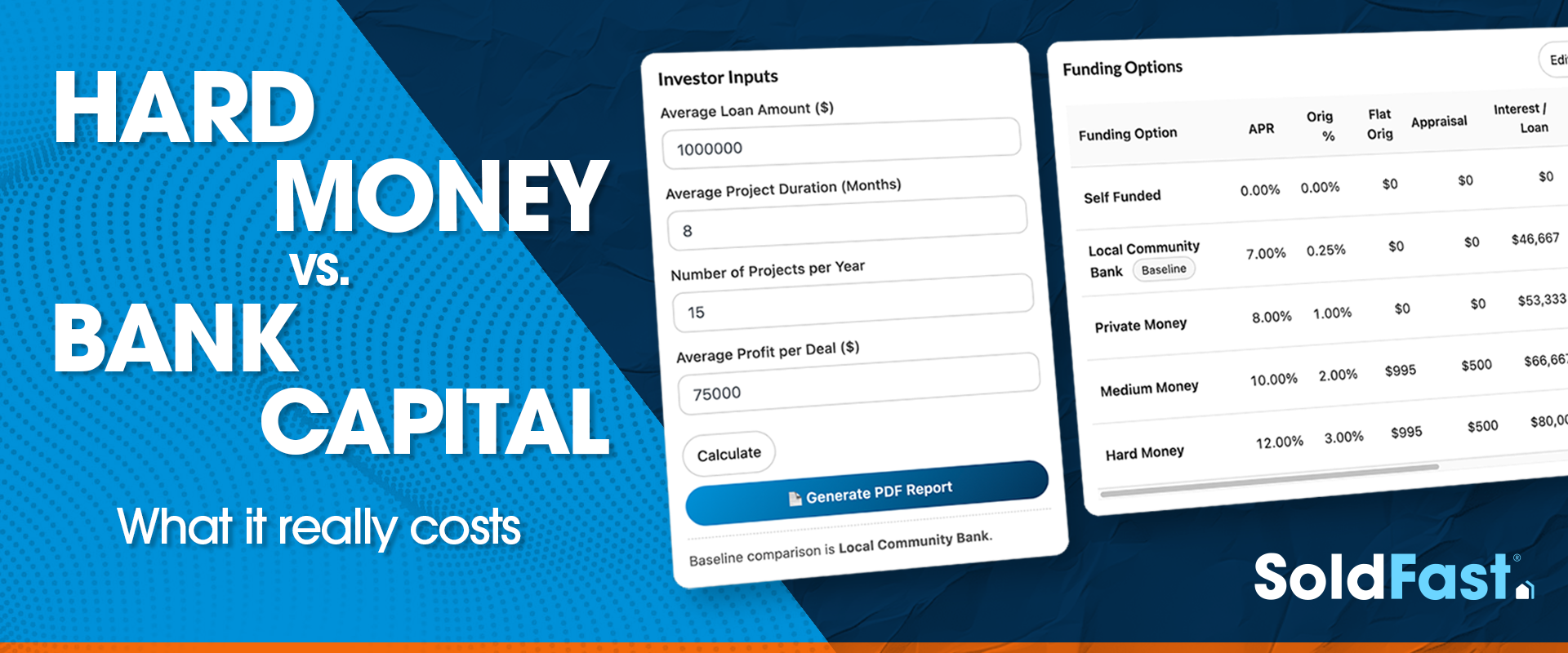
The SoldFast™ Cost of Capital Calculator
Real estate investors often use hard money out of convenience, without realizing what the terms and interest rate are actually costing them. Our priority is to obtain the lowest possible costs for capital from local community banks, which ensures the most competitive offers. Punch in your own numbers (or goals) and see just how much your capital is costing you.
Compare funding options and see annual cost + impact on profit.
Investor Inputs
Funding Options
| Funding Option | APR | Orig % | Flat Orig | Appraisal | Interest / Loan | Origination / Loan | Capital Cost / Loan | Annual Cost | Savings vs Bank | Gross Profit / Yr | Profit Impact |
|---|
Whenever you’re overpaying for capital, you’re also underpaying sellers in your community for their property. By reducing our costs and working towards mutually beneficial deals, we have a more positive impact in our market!
What Funding Types Are Best for Real Estate Investors?
Investors like you have multiple funding options with different lenders, and each type offers their own unique benefits and drawbacks.
Hard money = Fast and easy to access, hard money refers to asset-based loans from high-interest, higher-risk lenders. It’s called “hard” money because the tangible property itself is the collateral. Approval is also based on the value of the property, rather than your income or credit score documentation. These loans are short-term, ranging from 6 months to 2 years, and may also be sold to other buyers on the secondary market.
New investors with limited experience are more likely to rely on this type of funding, as are investors working on condemned or uninhabitable properties ineligible for other forms of financing.
Medium money = Usually a 3-5 year-term loan from national, big-ticket lenders that more established investors use. They’re still considered a form of hard money because of the fees and interest rates, but with less risk.
This type of funding benefits investors who have more time to work on their projects, and if they do work across state lines. Sometimes called “bridge” loans because they bridge the gap as investors secure long-term, more conventional financing.
Local bank = These smaller, local banks don’t resell their loans to other investors or private equity firms on the secondary market, and are quick to offer this kind of funding to secure the long-term “relationship” (i.e. your deposit accounts) with you.
Investors operating within a market niche and in need of reliable, sometimes-custom financing seek out these banks, as do investors prioritizing long-term relationships with established partners.
Private = Not always a formal lender, private funding can also come from small investment firms, other real estate investors, and even friends or family. Terms will vary depending on the lender’s needs.
You may want to explore private funding if your property doesn’t meet the criteria for traditional loans, or if a speedy process and flexibility are top priorities.
Self funding = Entirely personal funds from your own deposit accounts. All profit and risk is yours.
As investors cement partnerships and streams of income, self-funded projects become more feasible. Experienced investors who know the markets and how to navigate tough projects will see a much higher ROI. Self-funding is also ideal for investors who specialize in distressed properties and real estate sold at auction.
But why does the funding type matter to investors? If an investor is relying on something like hard money, the high interest rate debt from the loan means offers they take to sellers will be tens of thousands of dollars lower than funding from lenders that are more well-qualified or “bankable”. Investors who research and seek out the best lenders in a given market will be able to provide the most secure offer.