
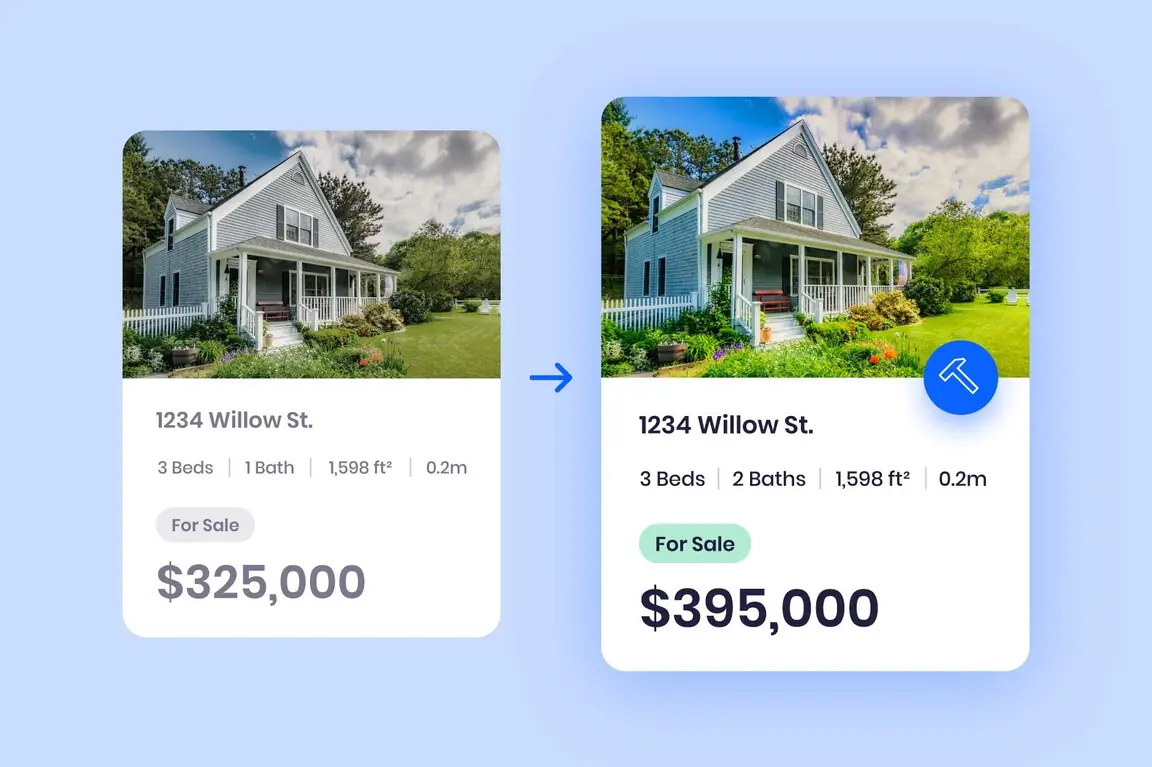
If you’ve ever watched a home renovation show, you’ve seen someone buy a rundown house, fix it up, and sell it for a big profit. But have you ever wondered how they know which properties are worth buying in the first place? A lot of that comes down to their estimates of the properties’ After Repair Value, or ARV.
New investors or investor-agents need to know why generating accurate ARV estimates is so important to their long-term success. In this guide, we’ll break down why ARV matters in certain real estate deals, what factors go into calculating it, and which renovation projects can actually move the needle concerning the home’s value.
What Is ARV?
After Repair Value is the estimated market value of a property after renovations are done. Instead of looking at what a home is worth right now, the ARV focuses on what it could be worth once all the necessary work is done.
Since you won’t know a home’s ultimate sell price until the actual sale, ARV is based on comparable sales, known as comps. Similar homes in the same area that have already been updated and sold are a great way to understand how those updates improve the property values. For example, if an investor renovates the kitchen and replaces the garage door, the most useful comps would be nearby homes that had those same types of updates.
The goal is to get as accurate a picture as possible of what buyers in that market are willing to pay for move-in-ready homes with specific improvements.
Why Does ARV Matter?
ARV is one of the most important numbers in fix-and-flip investing and other value-add real estate deals. It’s the starting point for almost every financial decision involved in the process. But how can it impact the sale?
It Determines the Investor’s Maximum Purchase Price
Investors use a common guideline called the 70% Rule to figure out how much they can (and should) pay for a property:
Maximum Purchase Price = (ARV x 0.70) minus Repair Costs
The 30% that gets left out isn’t just profit, but a buffer that covers closing costs, holding costs like property taxes and insurance during the renovation, and selling costs like agent commissions. Without that cushion, a deal can quickly go from profitable to a painful loss.
It Affects Financing Options
When investors need a loan to for the property, lenders like banks often base the loan amount on a percentage of the ARV rather than just the purchase price. This is common with rehab loans and bridge loans. Since the lender is factoring in the home’s future value, they are often willing to lend more than what the current condition would suggest. That said, they typically cap the loans at 65 to 75 percent of ARV to protect themselves.
It’s the Foundation of the Deal’s Other Numbers
In cases where the ARV estimate is off, every other number in the deal can be off too. An inflated ARV can make a bad deal look good on paper, which is a disaster waiting to happen. That is why investors spend so much time getting their numbers right before committing to a purchase.
Main Factors of an ARV Estimate
Calculating ARV is not an exact science, but there are five key factors that most investors and appraisers look at to arrive at a reasonable number.
Current Condition: The first step is understanding what the property actually needs. Investors look for clear signs of damage, outdated utilities, and anything else that could hold the property back from selling. A thorough walkthrough, sometimes with a contractor, helps reveal hidden costs that could change their estimate significantly.
Comps: Comparable sales are the backbone of any ARV estimate. Investors look at homes with similar features that sold recently in the same area, ideally within the last three to six months and within about a mile of the subject property. The comps should reflect the same upgrades planned for the renovation, not just the same size or location.
Appraisal Value: A licensed appraiser’s report is also an estimate of a home’s value, and lenders often require one before issuing a loan. Appraisers look at the home’s condition, as well as the surrounding area and nearby sales. They also factor in things that affect the lot itself, like heavy traffic on an adjacent road, that a simple comp search might miss.
Price Per Square Foot: The most straightforward way to estimate ARV, you can find the average price per square foot from your comps and multiply it by the property’s total square footage. From there, adjustments can be made for differences in features, layout, or condition. This method works best when the comps are very similar to the subject property, and tend to work best for experienced investors.
Get Input from Real Estate Professionals: Seasoned agents, investors, and contractors who have worked in the same area bring a higher degree of local insight that no formula can account for. They may know what buyers in that neighborhood are willing to pay for specific finishes or layouts, or can flag renovation plans likely to overshoot what the market supports.
5 Common Renovation Projects That Increase ARV
Not every renovation translates into a perfect ROI that raises the selling price. Some upgrades bring a consistent strong return, while others simply lower the risk buyers walk away. In fact, many will barely move the needle at all. Being smart about which renovations to make is what separates a smart renovation budget from an expensive one.
- Adding Square Footage or Bedrooms and Bathrooms: More livable space is the most reliable driver of value. Buyers and appraisers both respond to a higher bedroom and bathroom count, and price-per-square-foot comps go up when you add usable space. As expected, these projects also tend to have the highest costs, especially when the foundation or lot needs to be altered. You’ll see a bigger return, but make sure you have the experience and resources for these larger projects.
- Kitchen Remodels: The kitchen is often called the heart of the home, and buyers treat it that way, making an update here another strong option. Redoing cabinets, countertops, and appliances, or opening up a cramped layout, leaves a good impression. Just make sure to keep the finishes in line with what the neighborhood supports (more on that later).
- Bathroom Remodels: A clean, updated bathroom is almost as high on buyer wish lists as the kitchen is. Replacing outdated fixtures or refreshing tile and flooring can make the space feel brand new. As with kitchens, investors stick to neutral choices. Bold colors or highly specific design choices are exciting, but can turn buyers off rather than draw them in.
- Curb Appeal Upgrades: First impressions matter. It may be hard to believe, but since the garage door often takes up such a large portion of a home’s front-facing façade, replacing it with a more attractive design tends to offer one of the best returns of any single project of 90%+. Fresh exterior paint, updated landscaping, and a new front door are also relatively affordable ways to boost a home’s visual appeal.
- Paint and Flooring: Interior paint and new flooring aren’t glamorous, but they are two of the single most impactful and cost-effective improvements available. A fresh coat of neutral paint and clean, modern floors makes many homes feel more move-in ready, which is a top priority most buyers want.
And 5 Renovations That Are Less Likely to Help ARV
- Finished Basements: In many parts of the country, below-grade spaces are not counted in a home’s square footage as part of the appraisal. That means that on paper, finishing a basement often costs more than it could add in total value. One exception: if you can convert part of a finished basement into a conforming bedroom, that additional room count is counted and may help with comps and ARV.
- Luxury Finishes and High-End Features: Appraisers value the quality category of a finish, but they don’t pay mind to the specific brands and materials. A high-end, imported marble countertop can be appraised the same as a well-made standard quartz countertop. Spending significantly more on materials does not guarantee a higher ARV.
- Swimming Pools: A pool sounds appealing when everyone is out in the heat, but serious buyers are more cautious about them. Ongoing maintenance, safety/liability concerns, and the cost of insurance is more than enough to make buyers hesitate. As a result, pools add little to ARV in most markets and can sometimes make a home harder to sell.
- Customized/Hobby Rooms: Home offices have very broad appeal, but more niche functional spaces like a dedicated home theater or gym is a different story. Buyers enjoy the idea, but they rarely want to pay thousands of dollars more for one. These spaces serve the current owner’s lifestyle more than they attract future buyers.
- Renovations That Exceed the Neighborhood’s Price Range: This is a big one to watch out for. Even if you focus on high-value upgrades, don’t let them price the home far above what similar homes in the neighborhood sell for. Remember, investors and appraisers rely on local comps, so a home that outpaces its neighbors can struggle to appraise at the eventual sale price. Even if the renovations are high quality, they may not be advertised to the market’s ideal buyers.
Other Things to Consider About How ARV Factors into Real Estate Deals
Comparing ARV to As-Is Value
Lenders and investors look at both the current value and the ARV to decide whether a deal is worth pursuing. The gap between the two numbers, compared to the cost of repairs, shows the potential upside. The larger the gap, along with a reasonable repair budget, the more attractive the deal. A small gap or higher repair costs makes it much harder for the numbers to work.
It’s Not the Priority with Simpler Flips
Not all fix-and-list situations need major renovations. Some investors, particularly those who also work as real estate agents, focus on properties where the home’s condition is not a major concern. They’ll make simple updates like fresh paint and new flooring, but their main value comes from leveraging their professional network to connect sellers with the right buyers. ARV still matters in these cases, but the gap between as-is value and ARV is smaller by design.
Market Timing Is Also Important
Bigger renovations take more time, and that time adds to the total risk. If a project takes six months and the market softens significantly during that window, the ARV estimate made at purchase may no longer reflect what buyers are willing to pay. This risk is primarily in the fastest-growing neighborhoods, where contractor availability is limited and timelines are stretched. Investors in these markets need to build some cushion into their projections to compensate.
Appraiser and Investor Estimates Will Be Different
Appraisers can be conservative with their estimates, so they’ll stick to recent comparable sales and follow their reporting guidelines. Experienced investors, on the other hand, may have a more optimistic view of what a finished property can sell for, especially if they have a longer track record in that specific market. Neither approach is wrong, but understanding the difference matters if you are planning to use the ARV to make big financial decisions. When in doubt, the more conservative estimate is the safer one to plan around.
Measure Twice, Cut Once: Getting the ARV Number Right
After Repair Value is one of the most useful tools in a real estate investor’s toolkit. It turns a rough idea, “I think this house could be worth more after some work,” into a number that can be tested against actual costs and comparable sales.
The key is getting that number right. Use strong comps, be honest about what the property needs, and resist the temptation to over-renovate beyond what the neighborhood will support. As long as ARV is calculated carefully and the right renovations are chosen to match it, the path from a fixer-upper to a profitable sale becomes much clearer!