
Date Published: January 20, 2026
Last Updated: February 10, 2026
Download Dataset: Xlsx
Each state has their own laws for tenants and landlords, so it’s important to stay aware of how your state supports tenant and landlord rights.
Millions of people in the United States have housing through rentals, like an apartment, townhouse, or condo. Through the terms laid out in the lease agreement, tenants and landlords can enforce things like habitability standards and notification requirements. While some rights are consistently found in every state’s laws, there are also major differences when it comes to specific regulations. For smaller-scale investors, landlords and other property management professionals, keeping track of all this information can be a massive headache.
Regardless, understanding your state-specific laws, rules, regulations, and protections regarding tenant rights is vital when determining how to best sell or manage your rental property. That’s where SoldFast can help.
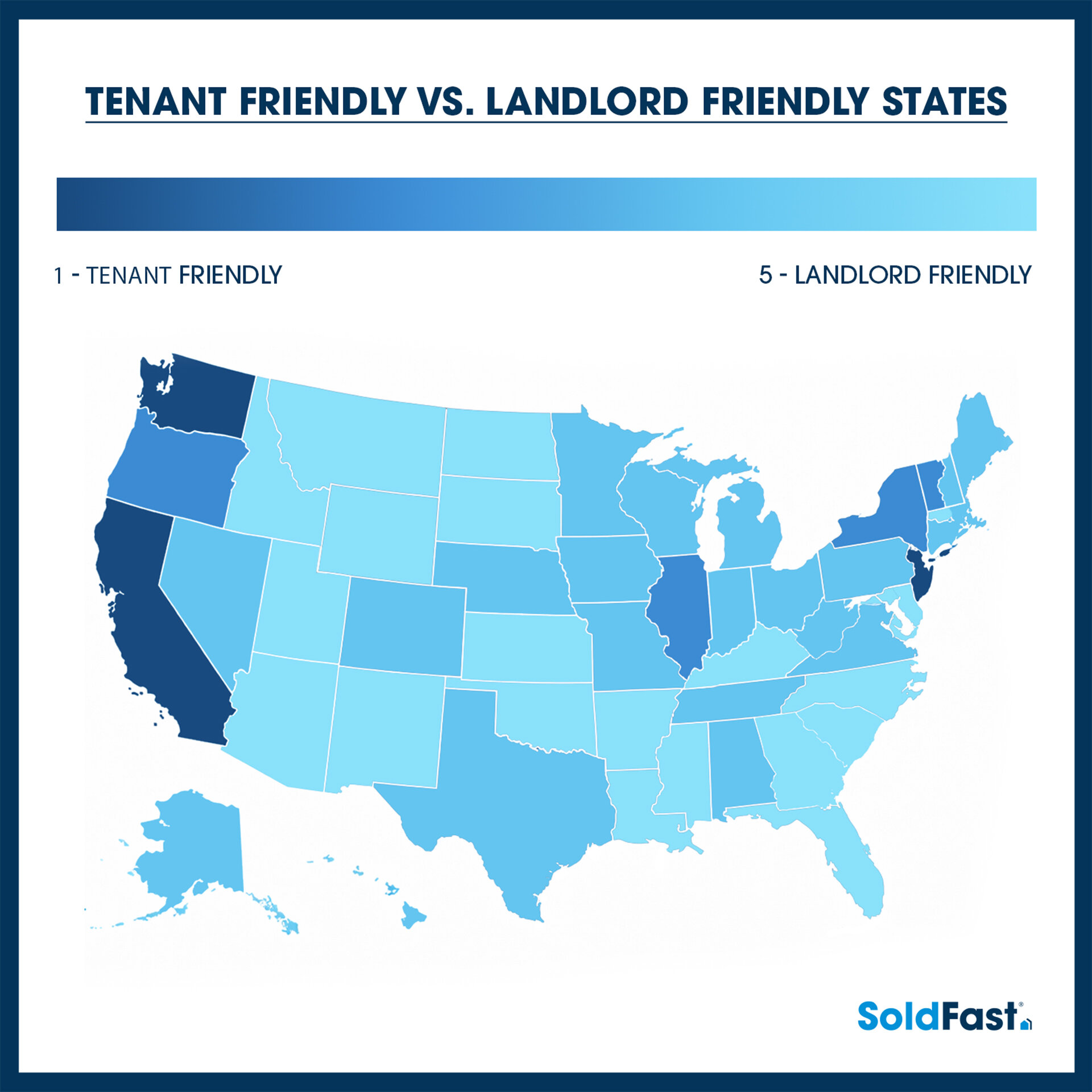
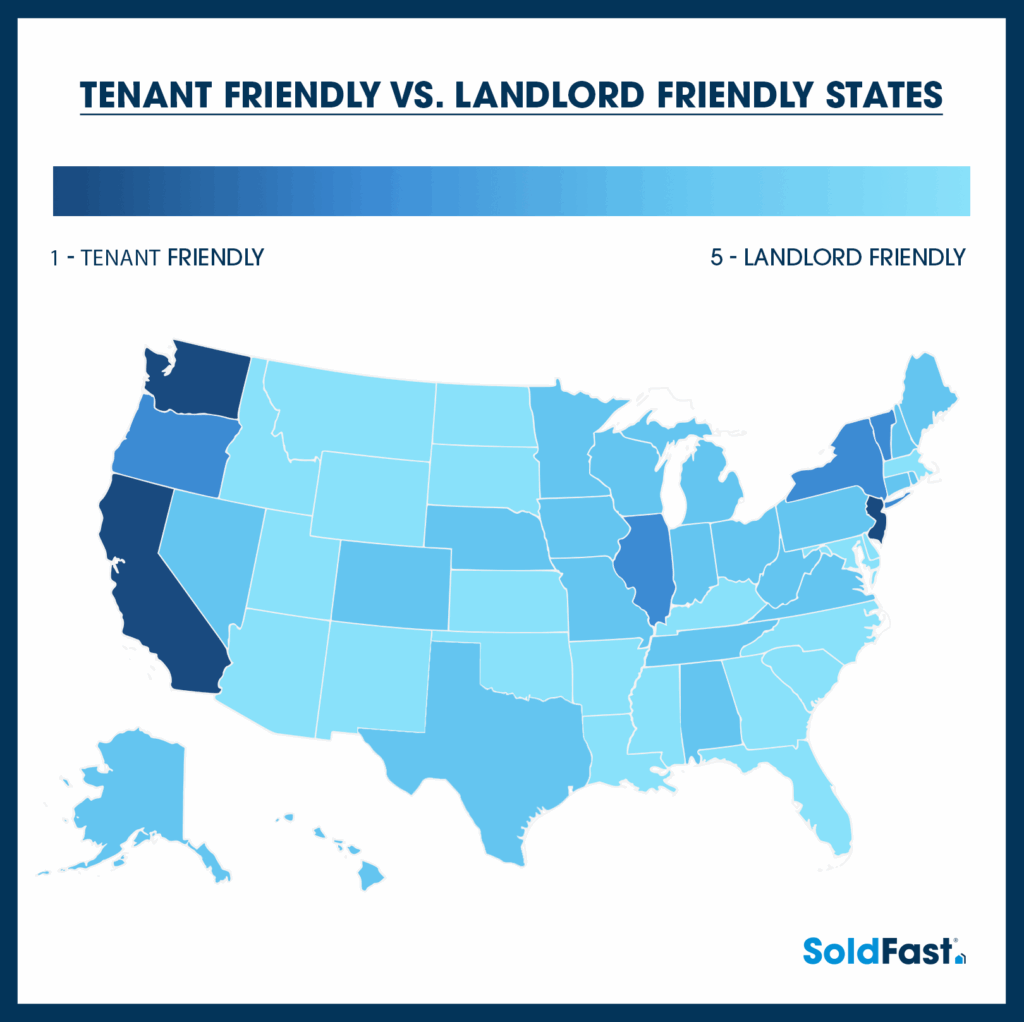
We compiled the core tenant and landlord rights for all 50 states, illustrating whether states are more tenant-friendly or landlord-friendly on a 1-5 rating system. These ratings are based on available data like effective property tax rates, eviction notice requirements and average timelines, squatter’s rights, local rent control programs and more. If you’d like more information, we have a complete guide to our methodology here.
Remember that some states will have additional regulations at the local level, usually for large metros like Chicago and New York City. We’ll include some of the most prudent examples, but it’s always a good idea to confirm any local regulations concerning rental properties before you move forward with any new investment opportunities. While we’ve done our best to draw from primary sources like state laws, this should guide be considered general information and not legal advice, especially when laws and regulations are routinely updated.
Regardless, we’re planning on keeping an eye on these stats, and making updates quarterly or when something big happens, so check back in often to see if they’ve changed! In the meantime, click the links below to find your state’s tenant and landlord rankings for 2026:
Is Alabama a Tenant or Landlord-Friendly State?
Laws: Alabama includes most of its regulations for landlords and tenants in the Uniform Residential Landlord and Tenant Act, found in Alabama Code Title 35, Chapter 9A-421 through 9A-461.
Resources: Residents can seek free legal aid through Legal Services Alabama, and the Alabama Center for Dispute Resolution offers mediation services.
Full table for Alabama
| Factor | Rationale | Score (1-5) |
|---|---|---|
| Formal Landlord/Tenant Act | Some tenant protections exist within the Uniform Residential Landlord and Tenant Act, but they are routine and tend to also benefit landlords when parties are following statutory guidelines (Alabama Code § 35-9A-101). | 4 |
| Rent Control or Stabilization Programs | There’s no statewide rent control program, and any local control is preempted by Alabama law, so landlords have full flexibility to set and raise prices. You can find the preemption under Alabama Code § 11-80-8.1, enacted in 1993. | 5 |
| Regulatory Burdens | There isn’t any form of statewide mandatory inspection program — which means minimal regulatory burden on landlords. Any mandated inspections are going to come from city-level programs and are usually restricted to building code enforcement. | 5 |
| Potential Eviction Costs | Filing costs are pretty high for landlords, with several counties averaging between $250-300+ to submit paperwork. Other factors like lawyer’s fees or lost rent amounts are too variable (Tenth Judicial Circuit Court of Alabama). | 3 |
| Average Eviction Rates and Timelines | 5–7 weeks is relatively slow compared to the rates you’ll find in states with similar, landlord-leaning rankings. The most recent available data for the state’s eviction rate is 3.8% in 2018 (Eviction Lab). | 4 |
| Required Notice Periods for Nonpayment/Lease Violations | 7 business days for nonpayment or a lease violation is fairly short, but a median that’s similar to what you’ll find in other states. 30-days for month-to-month leases gives these tenants more time, but overall the process is landlord-leaning for nonpayment. | 4 |
| Approximate Effective Property Tax Rates | The average effective property tax rate ranges from approximately .38% to .41%, but can be as high as .65% in Jefferson County where the state’s most populous city of Birmingham is (Jefferson County Tax Administration). | 4 |
| Adverse Possession Requirements (Squatter’s Rights) | Adverse possession is earned through 20 years of continuous, hostile, open, and exclusive possession. The state only requires 10 years of possession with “color of title”, however. | 4 |
| Rules on Security Deposits | Deposits are limited to no more than 1 month’s rent; Alabama’s 60-day return window for security deposits is fair, if longer compared to other states (A.C. 35-9A-201) | 4 |
| Rules on Late Fees | No caps on late fees are imposed by law, giving flexibility to landlords for the most part. “Unreasonable” fees can be contested, however, based on things like industry standards and administrative costs (A.C. § 35-9A-421). | 3 |
Verdict: Landlord-Friendly – 4 / 5
- Favors landlord flexibility thanks to short nonpayment notice requirements, and relatively fast evictions in many counties.
- Still, Alabama has many common tenant protections like limiting deposits and holding some habitability standards.
- Cities like Birmingham have additional housing regulations for some public developments to protect their low-income residents.
Is Alaska More Tenant-Friendly or Landlord-Friendly?
Laws: Alaska’s legislation for rental properties is mostly found in Alaska Statutes Title 34, Chapter 03.
Resources: Alaska Legal Services Corporation is a non-profit providing free civil legal assistance to low-income Alaskans. They can direct tenants to resources covering security deposits, evictions, housing conditions, discrimination, and more.
Full table for Alaska
| Factor | Rationale | Score (1-5) |
|---|---|---|
| Formal Landlord/Tenant Act | The state features a standardized bill of rights with the Alaska Landlord and Tenant Act and offers a state-published tenant/landlord guide specifying things like deposit rules, habitability duties, and other core obligations/rights (Alaska Statutes Title 34, Chapter 3-010 – 03.380). | 4 |
| Rent Control or Stabilization Programs | There are no rent control programs in Alaska, so landlords can set and raise their rent prices as they see fit. Anchorage has looked at providing rental assistance to tenants after eviction, but no program is currently in place. | 5 |
| Regulatory Burdens | Local inspections vary by county, focusing on code enforcement, rental registrations and habitability standards. Very common for landlord-leaning states, but there are also rules favoring tenants with deposit and late fee handling (A.S. § 34.03). | 5 |
| Potential Eviction Costs | The Alaskan Court System lists average filing fees of $150, and $250 if damages exceed $100,000. High markup for most things due to the state’s isolation adds to landlords’ potential financial burden (Alaska Court System). | 4 |
| Average Eviction Rate and Timelines | Uncontested evictions may be wrapped up within 6-8 weeks, but it’s heavily dependent on the county due to Alaska’s size. What eviction rate data is available puts the state at 2.8%, and difficult weather conditions + traveling distance can delay the process. | 3 |
| Required Notice Periods for Nonpayment/Lease Violations | The short, but average notice period of 7 days for “pay-or-quit” evictions favors landlords in most cases. Interestingly enough, certain lease violation notices may require shorter notice periods of as little as 5 days. In most cases, lease violations will require 10 days’ notice (A.S. § 34.03.220). | 4 |
| Approximate Effective Property Tax Rates | Alaska’s effective property-tax burden is low compared to many states, but highly variable depending on the region. Anchorage has a rate of 1.29%, while rural counties in the Arctic have rates as low as .29%. Not exactly common to build apartments that far north. | 4 |
| Adverse Possession Requirements (Squatter’s Rights) | Alaska allows possession after 10 years with good faith belief that the property belongs to you, or in 7 years with “color of title”. This is on the shorter end of things and may partly stem from the state’s rugged landscape. | 3 |
| Rules on Security Deposits | Deposit rules are regulated but very manageable for landlords. Deposits are capped at 2 months’ rent and must be returned within 30 days of moving out. These deposits must also be held in an interest-bearing account (A.S. § 34.03.070) | 4 |
| Rules on Late Fees | There is no statewide cap on late fees, but they must be considered “reasonable” and clearly specified within the landlord-tenant guide (A.S. § 34.03.020). | 3 |
Verdict: Somewhat Landlord-Friendly – 3.8 / 5
- Alaska offers landlords meaningful protections through a lack of rent control, short nonpayment notices, and very limited statewide inspection mandates.
- That short adverse-possession window is unusual, even among states that are solidly more tenant-friendly.
- The Anchorage Assembly has considered a mandatory relocation assistance program, which would provide 2 months’ rent for tenants required to vacate. It’s unclear if this will make it to the governor’s desk, though.
What Are the Tenant and Landlord Laws in Arizona?
Laws: You can find the laws relating to rental agreements between tenants and landlords in Arizona Regional Statutes Chapter 33.
Resources: Renters can find resources from organizations like the Arizona Tenants Advocates and Arizona Multihousing Association.
Full table for Arizona
| Factor | Rationale | Score (1-5) |
|---|---|---|
| Formal Landlord/Tenant Act | Arizona has a Residential Landlord & Tenant Act for both standard rentals and mobile homes. While current protections aren’t as robust as other states, an “Alternative Business Structure” program allows nonlawyers to own stake in legal firms, which could help expand access to legal justice in cases relating to rental housing. | 4 |
| Rent Control or Stabilization Programs | The state legislature took steps to preempt cities and counties from imposing local rent control on private residential housing (Arizona Revised Statutes § 33-1329 and § 33-1416). | 5 |
| Regulatory Burdens | Many common inspection and habitability mandates are enforced. As of January 2025, Arizona ended their Transaction Privilege Taxes to reduce housing costs, but properties must still be registered with County Assessors. Much of the state’s regulations focus on short-term rentals. | 4 |
| Potential Eviction Costs | Some available data includes $65 for Arizona Justice Court, or $218 at Superior Court. The typical rent for Maricopa County is around $1,700 monthly, so ~$3000 in lost rent is possible (Eviction Lab). | 4 |
| Average Eviction Rates and Timelines | With short statutory notice periods and fast court processing, a typical uncontested evictions may be complete within 2–4 weeks. | 4 |
| Required Notice Periods for Nonpayment/Lease Violations | For nonpayment and serious violations, Arizona law requires a 5-day written notice (A.R.S. § 33-1368). 10-day notice is common for fixable issues like minor damage. | 5 |
| Approximate Effective Property Tax Rates | Arizona’s effective property-tax rate is relatively low (~0.44% effective rate), though absolute tax bills will depend on the assessed values and local levies. With surging growth, the state’s property values have continued to rise. | 4 |
| Adverse Possession Requirements (Squatter’s Rights) | Arizona adverse-possession laws generally require 10 years to recover land occupied openly/continuously (A.R.S. § 12-526). | 4 |
| Rules on Security Deposits | Statutes require landlords to provide an itemized list of damages and return tenants’ deposit money within 14 days, which is shorter than what you’ll find in other landlord-friendly states. | 3 |
| Rules on Late Fees | Late fee caps are only allowed for mobile homes, preventing late fees from exceeding $5 per day from the due date if payment is not made by the 6th day (A.R.S. §33-1414). Apartments and other rentals have no cap other than guidelines for “reasonableness”. | 5 |
Verdict: Landlord-Friendly – 4.2 / 5
- Arizona strongly favors landlords on some core items, including state preemption of local rent control and a fairly short pay/quit notice period of 5 days compared to other states.
- But tenant protections include a short, 2-week deposit return window and statutory limits on late fee penalties.
- Evictions have gone up in Maricopa County (the state’s most populated) in recent years. Like most of the country, they spiked during Covid, but evictions in Arizona continue to climb. Eviction Lab noted that many Sunbelt states were facing increased rates.
Are Landlords or Tenants More Protected in Arkansas?
Laws: Look for the laws pertaining to landlord and tenant agreements in Arkansas Code Title 18.
Resources: Arkansas Law Help provides free civil legal assistance to low-income Arkansans relating to tenant rights, eviction processes, and other housing-related issues as well as through self-help resources and links to legal forms.
Full table for Arkansas
| Factor | Rationale | Score (1-5) |
|---|---|---|
| Formal Landlord/Tenant Act | The state’s Residential Landlord-Tenant Act of 2007 provides standard protections like lease termination rules and eviction procedures, and overall giving landlords stronger rights. | 4 |
| Rent Control or Stabilization Programs | Arkansas has no statewide rent-control or rent-stabilization statute, so nothing limits how much landlords may raise rent. Recent bills have reinforced the state’s general stance (House Bill 1706). | 5 |
| Regulatory Burdens | There is no statewide rental-inspection program; inspection and code-enforcement responsibilities rest at local levels, focusing on code enforcement. Arkansas didn’t mandate habitability standards until 2021. | 5 |
| Potential Eviction Costs | Typical filing and service fees for uncontested cases are modest. Fort Smith’s District Court, for example, dictates fees between $65-80, while Circuit Court and county fees average $165 (District Court in Fort Smith). | 5 |
| Average Eviction Rates and Timelines | A lot of evictions wrap up in about 2–4 weeks, but that’s under normal circumstances without delays during court proceedings. The state generally tries to keep the process moving along, though. | 5 |
| Required Notice Periods for Nonpayment/Lease Violations | For nonpayment, landlords may give a 5-day notice to vacate before filing eviction, while lease-violation notices generally allow 14 days to cure or vacate. | 4 |
| Approximate Effective Property Tax Rates | Arkansas has generally low property-tax burdens compared to many states, with an effective rate of .53%. Along with typical housing values, holding costs are low for landlords. According to the city government, Little Rock’s rate is the highest at 1.4% as of 2025 (City of Little Rock, AR). | 4 |
| Adverse Possession Requirements (Squatter’s Rights) | Under adverse-possession rules, claimants need 7 years (with deed/color-of-title & paid taxes) for improved property or 15 years for wild/unimproved land. This is shorter than you’d think for how Arkansas handles other aspects of real estate law. | 3 |
| Rules on Security Deposits | Law limits the security deposit to no more than 2 months’ rent, and regulated landlords must itemize deductions and return the remaining deposit within 60 days after move-out (Arkansas Code §§ 18-16-304). | 4 |
| Rules on Late Fees | Arkansas does not impose a cap on late fees, so these and other charges depend on lease terms. For small-unit landlords, they don’t fall under any deposit-law regulation. Courts have decided that roughly 5-10% of rent is considered reasonable (A.C. §§ 18-17-401). | 3 |
Verdict: Landlord-Friendly – 4.1 / 5
- Arkansas offers landlords broad flexibility and enforces only modest regulatory constraints on deposits and inspections. There’s also a relatively low property-tax burden.
- Tenant protections exist and are usually based in procedural requirements; overall, Arkansas gives landlords more tools in usual situations.
How Tenant Friendly Is California?
Laws: California enforces laws relating to renters and landlords through Prop 13, Assembly Bill 12, and the Tenant Protection Act of 2019 (AB 1482).
Resources: As one of the more renter-friendly states, many different California counties provide free or low-cost mediation services for tenant-landlord disputes, while others also offer specific arbitration programs.
Full table for California
| Factor | Rationale | Score (1-5) |
|---|---|---|
| Formal Landlord/Tenant Act | The California Tenant Protection Act (Assembly Bill 1482) mandates robust tenant protections, with statutory procedures for enforcing deposit limits & return rules, habitability standards, and even just-cause eviction (DOJ). This Act was further strengthened in 2024. | 1 |
| Rent Control or Stabilization Programs | With the passage of A.B. 1482, most long-term residential rentals are subject to rent-increase caps, with an annual increase limit ≈ CPI + 5% and often max 10%. Not to mention that many cities have additional rent-control ordinances, like San Francisco. | 1 |
| Regulatory Burdens | There is no statewide inspection program, but many cities/counties impose some form of regulation. Landlords in urban areas will face routine inspections, registration or licensing requirements, and other mandates (California Dept. of Real Estate). | 2 |
| Potential Eviction Costs | Eviction filing and service fees plus associated court costs are substantial; just some filing costs come in at $240–$385. Contested cases add attorney fees and months of lost rent, leaving some landlords trying to recover thousands of dollars. | 2 |
| Average Eviction Rates and Timelines | Under the state’s eviction laws, even uncontested evictions can take 30–45 days or more. Contested evictions often stretch to 6–10 weeks or longer, and 2025 reforms extended response-times even further. | 2 |
| Required Notice Periods for Nonpayment/Lease Violations | For nonpayment or lease violations, landlords follow statutory notice requirements of 3-day pay/cure or quit, but just-cause rules and relocation-assistance requirements mean lots of “termination without cause” evictions are effectively blocked. | 2 |
| Approximate Effective Property Tax Rates | The statewide effective property-tax rate is relatively low due to Proposition 13, with assessed value increases capped and a base tax rate ~1%. Despite this, high property values in many areas still make absolute tax bills high. | 3 |
| Adverse Possession Requirements (Squatter’s Rights) | Adverse possession requires 5 years’ continuous possession under claim of right + paid taxes, which is one of the shortest windows overall. And as you can imagine, the state’s procedural requirements for removing a squatting tenant extend the timeline (C.C.P. § 325). | 2 |
| Rules on Security Deposits | With AB 12, deposits are now limited to 1 month’s rent and require itemized deductions. Returning the deposit, or remainder if there are damages, must be done within 21 days after move-out. There are some exceptions for landlords with 2 or fewer properties that have 4 or fewer individual units (California Department of Justice). | 2 |
| Rules on Late Fees | While late fees are allowed, they must be “reasonable”. Many landlords accept 5–10% of rent at most and the court system will scrutinize excessive fees. | 2 |
Verdict: Strongly Tenant-Friendly – 1.9 / 5
- It’s no surprise that California imposes a lot more constraints on landlords through statewide rent-control and just-cause eviction laws (thanks to AB 1482), along with local inspection requirements and one of the lengthiest eviction processes in the country.
- Additionally, cities like San Francisco feature their own rent-control ordinances or other regulations, which means another layer of complexity.
- While the property-tax structure via Proposition 13 provides some relief to landlords, overall the environment is clearly tilting in favor of renters.
Is Colorado a Tenant or Landlord-Friendly State?
Laws: Colorado Revised Statutes Title 13 covers most rental agreement laws for the state, but there are also county and city level regulations to consider, such as in Boulder and Denver.
Resources: Colorado’s Department of Housing connects renters with numerous resources, including free legal aid providers and self-help information. Additionally, premises located within the City and County of Denver must provide the Denver Tenant Rights and Resources Handbook to their tenants.
Full table for Colorado
| Factor | Rationale | Score (1-5) |
|---|---|---|
| Formal Landlord/Tenant Act | Colorado doesn’t have a formal Landlord & Tenant Act, so habitability, security deposit, and notice requirements are in various statutes. These protections are a bit more “reined in” than you might expect. | 3 |
| Rent Control or Stabilization Programs | Colorado preempted any sort of local rent control program, though some cities may impose extra limits. There are a few statewide rules, like capping rent on tenants’ pets (House Bill 23-1068). | 5 |
| Regulatory Burdens | Any rental property inspections are generally a local matter as well, but the state does enforce some regulatory rules like providing cause for eviction and disclosure for all fees. | 4 |
| Potential Eviction Costs | Filing and sheriff fees for uncontested eviction usually come in around a few hundred dollars. Jefferson County’s fee for the sheriff’s office is $130, and in Denver, a tenant’s answer to an eviction judgment costs $100 to file (Jefferson County Sheriff’s Office). | 3 |
| Average Eviction Rates and Timelines | There can be a decent amount of variety, with different situations wrapping up evictions between 2–8 weeks. On April 19, 2024, the state’s For Cause Eviction policy kicked in, so for no-fault evictions, landlords now need to provide 90 days’ notice (H.B. 24-1098). | 3 |
| Required Notice Periods for Nonpayment/Lease Violations | For nonpayment, landlords generally provide 10-day notices while other breaches allow 3–10 day notice periods depending on the situation. And as we mentioned above, notice must be given as much as 90 days in advance for no-fault evictions (Colorado Regional Statutes § 38-12-1303). | 3 |
| Approximate Effective Property Tax Rates | Colorado effective property tax rate is ~0.51%. In most cases, rates outside the Front Range metro will be lower. Expect the highest rates in the suburbs like Broomfield, Adams, and Douglas counties. | 4 |
| Adverse Possession Requirements (Squatter’s Rights) | Adverse possession requires 18 years of continuous & hostile use, but like a lot of states, color of title exceptions may reduce this. | 4 |
| Rules on Security Deposits | Colorado law limits deposits to 1 month of rent and requires its return or an itemized deduction within 30 days. 60 days is possible if it’s included in the lease. Also, landlords can’t use the deposit to cover “normal” wear and tear (C.R.S. § 38-12-507). | 3 |
| Rules on Late Fees | Late fees must be “reasonable” per lease, which is usually $50 or 5% of rent. Landlords need to give a 7-day notice before charging it, and a 180-day notice before its due date. | 3 |
Verdict: Somewhat Landlord-Friendly – 3.5 / 5
- Colorado favors landlords overall thanks to modest property tax rates and minimal inspection obligations.
- Eviction timelines and tenant protections are pretty balanced, and mandating the tenant rights handbook helps keep renters better informed of all their options, which is itself important when it comes to recognizing issues that may need mediation.
What Are the Tenant and Landlord Laws in Connecticut?
Laws: Connecticut houses its statutes for tenants and landlords in Connecticut General Statutes Title 47a, Chapter 830-32.
Resources: The Connecticut Judicial Branch Law Libraries provides extensive information about tenant rights and habitability standards, and served as a solid primary source for our information here. Calling 211 connects residents across the state with nearby housing resources, including rental assistance programs they can apply for.
Full table for Connecticut
| Factor | Rationale | Score (1-5) |
|---|---|---|
| Formal Landlord/Tenant Act | Connecticut didn’t formalize a Landlord-Tenant Act, but existing legislation still has strong statutory tenant protections, including habitability requirements, security deposit regulations, and anti-retaliation rules (Connecticut Department of Consumer Protection). | 3 |
| Rent Control or Stabilization Programs | While some cities in Connecticut historically regulated rental properties more heavily, there isn’t any statewide rent-control laws on the books right now. | 5 |
| Regulatory Burdens | Connecticut has no statewide mandatory rental-inspection program, so any inspection requirements are local (C.T.G.S. Landlord-Tenant Code). Larger cities like Hartfield and New Haven have additional rules through the Fair Rent Commissions, allowing tenants to challenge “excessive” rent hikes. | 5 |
| Potential Eviction Costs | The Connecticut Judicial Branch provides some info on fees for summary processes. In most cases they’re modest (~$80–100), and sheriff service fees add another $50-100. A range of $300-600 would be a strong estimate for average expenses in uncontested cases. | 3 |
| Average Eviction Rates and Timelines | Uncontested evictions take 4–8 weeks from notice to judgment, which is squarely in the middle of state rankings. (Connecticut Judicial Branch). | 3 |
| Required Notice Periods for Nonpayment/Lease Violations | For nonpayment, Connecticut law requires a 3-day notice to quit before filing eviction; other breaches allow 10–30 days depending on the lease type (CT Judicial Branch). | 4 |
| Approximate Effective Property Tax Rates | Connecticut has moderate to high property-tax rates, but less variation since the state itself is small and mostly urbanized; effective rates are usually around 1–2%. | 3 |
| Adverse Possession Requirements (Squatter’s Rights) | Adverse possession requires 15 years of continuous use for claiming property in Connecticut, while removal of any trespassers follows standard eviction/trespass procedures. | 4 |
| Rules on Security Deposits | Security deposits are capped at two months’ rent for unfurnished units, and must be returned with itemized deductions within 21 days after move-out or 15 days after receiving a forwarding address, whichever is later (CT Department of Consumer Protection). | 3 |
| Rules on Late Fees | 2023’s Senate Bill 998 added caps to late fees, with $5 a day to a maximum of $50 OR 5% of the delinquent rent, whichever is lower. There is also a 9-day grace period for monthly leases (CT Judicial Branch). | 2 |
Verdict: Somewhat Landlord-Friendly – 3.5 / 5
- Connecticut provides landlords a slight edge with the flexibility here, but like a lot of New England states, higher effective property tax rates increase holding costs.
- Eviction timelines and tenant protections are pretty standard, although the notice to quit period of 3 days for nonpayment is on the shorter side, and a window you’ll mostly find in states even more landlord-friendly.
- Senate Bill 998 made meaningful strides in tenant protections, increasing the regulatory burden on landlords in regards to proper handling of security deposits and late fees.
Does Delaware Offer More Protections for Landlords or Tenants?
Laws: Delaware Code Title 25 (Property – Residential Landlord-Tenant Code) Chapter 53 contains most of Delaware’s prudent laws and regulations involving landlords and their tenants.
Resources: The Delaware Code Online offers quick access to the state’s landlord and renter laws, while resources like financial aid programs are offered by the Delaware Housing Assistance Program.
Full table for Delaware
| Factor | Rationale | Score (1-5) |
|---|---|---|
| Formal Landlord/Tenant Act | The state’s formal Residential Landlord-Tenant Code provides expected protections for habitability and other standards but is generally considered balanced, not favoring one party more than the other (Delaware Courts). | 4 |
| Rent Control or Stabilization Programs | Delaware has no statewide rent-control law, allowing landlords to freely set and raise rent. While there aren’t any cities that try and enforce additional programs, the state does allow low-income residents free legal representation in housing cases. | 5 |
| Regulatory Burdens | No statewide mandatory rental-inspection program exists, but local level enforcement relating to licensing and inspections is found in Wilmington (Delaware Judicial Branch). | 5 |
| Potential Eviction Costs | Total filing and service fees look pretty modest at around ~$100–$200. Justice of the Peace Court charges $45 but don’t forget that the total can vary significantly. That being said, these lower costs are most likely unless the eviction is contested (Delaware Courts). | 4 |
| Average Eviction Rates and Timelines | Eviction typically takes 2–6 weeks for uncontested cases, and the rate has gone down over the last 12 months based on data from Eviction Lab. Wilmington saw a particularly step decline in the last couple of years and now hovers around 10% (Delaware Courts). | 4 |
| Required Notice Periods for Nonpayment/Lease Violations | For nonpayment, landlords provide a 5-day notice to pay rent or vacate. As for most lease violations, landlords generally allow 7 days to resolve the issue before filing (Delaware Courts). Tenants renting a mobile home are allowed between 10-12 days | 3 |
| Approximate Effective Property Tax Rates | Delaware’s property-tax rate is fairly low at an effective rate ~0.5–0.6%, and of course actual bills vary by county. New Castle County recently cut rates, although other taxes for the district will recoup some of those losses and keep the total rate ~.76%. | 4 |
| Adverse Possession Requirements (Squatter’s Rights) | Delaware law requires 20 years of continuous, hostile possession to claim any property, while removal is your typical standardized legal process with sheriff enforcement. | 4 |
| Rules on Security Deposits | Security deposits can’t go over 2 months of rent and must be returned with an itemized statement within 20–30 days after move-out. (Delaware Code Title 25 § 5501). | 4 |
| Rules on Late Fees | Late fees aren’t capped if the amount is specified in the lease, and like usual any listed fees must be considered reasonable according to general contract principles. | 3 |
Verdict: Landlord-Friendly — 4 / 5
- Delaware is ultimately a bit more landlord-leaning due to faster eviction timelines, moderate deposit/late fee rules, and comparatively low property taxes at .6%. High overall property values, however, mitigate things a bit. It should also be noted that this is an increase compared to previous years, which featured rates as low as .43%.
- Standard tenant protections exist but are balanced, maintaining an environment that’s mostly favorable environment for landlords.
- Wilmington, however, adds a number of management burdens, such as mandatory licensing and stricter inspection standards.
What Are the Landlord and Tenant Laws in Florida?
Laws: Browse Florida’s regulations for tenants and landlords within Florida Statutes Chapter 83, Part II.
Resources: Information and links to available programs relating to protecting landlord/tenant rights are available from Florida’s Department of Agriculture and Consumer Services.
Full table for Florida
| Factor | Rationale | Score (1-5) |
|---|---|---|
| Formal Landlord/Tenant Act | Florida’s Residential Landlord and Tenant Act provides all the standard tenant protections: habitability standards, deposit return windows, and the eviction procedures. In general, these laws favor landlords. | 4 |
| Rent Control or Stabilization Programs | Florida passed House Bill 1417 in 2023, preempting local rent control programs and overriding tenant protections with state-sponsored rules. The state’s “Live Local Act” or Senate Bill 102, also works to restrict local measures. | 5 |
| Regulatory Burdens | Minimal regulations are placed on landlords. In fact, Florida is trying to address its housing crisis through landlord/developer incentives like laxed zoning laws or tax breaks when the required percentage of housing is affordable (S.B. 102). | 5 |
| Potential Eviction Costs | The Florida court system offers some example filing fees that hover around ~$185, while sheriff services average between $50-75 (Florida Courts). Expect the paperwork to cost several hundred dollars. | 4 |
| Average Eviction Rates and Timelines | Florida evictions for either nonpayment or lease violations typically take 2-6 weeks to complete if they’re uncontested. Eviction Lab’s tracked evictions in Florida cities show positive signs: rates are down across most metros except Jacksonville and Gainesville at 0% and 2% respectively (Eviction Lab). | 4 |
| Required Notice Periods for Nonpayment/Lease Violations | Landlords must provide a 3-day notice to pay or vacate for nonpayment, and a 7-day notice for noncompliance with lease terms. The 3-day notice for nonpayment is very common in landlord-friendly states (Florida Statutes § 83-56). | 5 |
| Approximate Effective Property Tax Rates | We find the rare use of a statutory cap here, in the form of a 10% Non-Homestead Cap that limits property value increases to 10% of assessed value each year. As a whole Florida has relatively low effective property-tax rates compared with many states, with an average between .89% and .99% (Property Appraiser of Miami-Dade County). | 4 |
| Adverse Possession Requirements (Squatter’s Rights) | Adverse possession requires 7 years of continuous possession with claim of ownership and taxes paid. The period of time goes up to 10 years if you can’t produce color of title. Standard eviction laws follow the procedures found in plenty of other states. | 4 |
| Rules on Security Deposits | Security deposits have no statutory cap, but landlords need to return them or provide an itemized list of deductions within 15-60 days depending on lease terms. (Florida Statutes § 83-49). | 4 |
| Rules on Late Fees | Late fees must be reasonable, often around 5%, and be clearly specified in the lease. For mobile/manufactured rentals, Florida law caps any fees at $20 or 20% of monthly rent (Florida Statutes § 83-56). | 4 |
Verdict: Strongly Landlord-Friendly — 4.3 / 5
- Florida is one of the more landlord-favorable states due to fast evictions, short notice periods, modest property taxes, and no cap on security deposits.
- Tenant protections exist but are standard.
- Rising insurance costs along coastal areas are one of the more unique aspects of the state’s overall risks for property investors and managers, with stronger and more frequent storms impacting many of the state’s most popular communities.
What Are the Landlord and Tenant Laws in Georgia?
Laws: Georgia laws pertaining to property rental rights and responsibilities are found in Georgia Code Title 44, Chapter 7.
Resources: The Georgia Department of Community Affairs can provide information about landlord requirements and tenant protections. The DCA used to provide a rent and utility assistance program but sunsetted it as of September 30, 2025.
Full table for Georgia
| Factor | Rationale | Score (1-5) |
|---|---|---|
| Formal Landlord/Tenant Act | Georgia law provides basic tenant protections such as habitability, security deposits, and eviction procedures, but overall favors landlords. The recent House Bill 404 introduced new protections like security deposit caps. | 4 |
| Rent Control or Stabilization Programs | No programs are in place, and the state legislature preempted any control at the city/county level. | 5 |
| Regulatory Burdens | Known as Georgia’s “Safe at Home Act”, H.B. 404’s standards and caps placed some new burdens on landlords to meet these requirements. That being said, Georgia is one of the last states to establish things like habitability standards. This state still firmly favors landlords. | 4 |
| Potential Eviction Costs | According to Georgia Legal Aid, many state filing fees total somewhere between $100–120. One example is $60 from the Magistrate Court of Fulton County and does not include service fees or cases with additional defendants (Official Code of Georgia Annotated § 15-10-80 and § 36-15-9). | 4 |
| Average Eviction Rates and Timelines | Depending on the situation, evictions in Georgia can be expected to wrap up within 3-6 weeks, and likely on the shorter end for uncontested cases. | 4 |
| Required Notice Periods for Nonpayment/Lease Violations | For nonpayment of rent, Georgia requires the shorter 3-day notice to pay or quit, while lease violations have no statutory notice window. Landlords may still include them in the lease terms, however(O.C.G.A. § 44-7-50). | 5 |
| Approximate Effective Property Tax Rates | Georgia has moderate property-tax rates between .77% and .83% of assessed value. If you’re more than 120 days late with payment, a 5% penalty is added, with subsequent increases every additional 120 days to a maximum of 20% (O.C.G.A. § 48-2-40-44). | 4 |
| Adverse Possession Requirements (Squatter’s Rights) | Adverse possession will require 20 years of continuous possession, but Georgia allows a surprising jump down to just 7 years with color of title. This is in hope that most applicable cases involve the “squatter” acting more like a good-faith owner. | 4 |
| Rules on Security Deposits | Security deposits are limited to one month’s rent unless the lease agreement states otherwise; regardless of the amount, deposits must be returned within 30 days including any itemized deductions for damages (O.C.G.A. § 44-7-30 to § 44-7-37). | 4 |
| Rules on Late Fees | Very common statutes here; late fees aren’t capped and are expected to be reasonable to avoid being contested (O.C.G.A. § 44-7). | 4 |
Verdict: Strongly Landlord-Friendly — 4.3 / 5
- Like most landlord-leaning states, Georgia preempts local rent control and offers quicker eviction timelines and low property taxes.
- Solid tenant protections exist, and in fact got stronger between 2024 and 2025 in response to the state’s growing population and symbolic resolutions championed in Atlanta. There are now habitability standards, although other changes benefit landlords, such as how notification windows have been increased for nonpayment and lease violations.
Is Hawaii Better for Tenants or Landlords?
Laws: The Residential Landlord-Tenant Code is found in Hawaii Revised Statutes Chapter 521, and is available online from the Department of Commerce and Consumer Affairs.
Resources: Landlord-Tenant Information Center at (808) 586-2634, and organizations like Maui Mediation Services can provide assistance to tenants. The Hawaii Public Housing Authority offers housing vouchers.
Full table for Hawaii
| Factor | Rationale | Score (1-5) |
|---|---|---|
| Formal Landlord/Tenant Act | The state’s Residential Landlord-Tenant Code, under Hawaii Revised Statutes Chapter 521, sets most of the common protections on habitability standards, disclosures, and deposit return rules (Hawaii Department of Commerce and Consumer Affairs). | 3 |
| Rent Control or Stabilization Programs | Hawaii doesn’t enforce any statewide rent control program, although there may be temporary exceptions. For example, in the past rents were frozen on the island of Maui while disaster relief efforts were underway. | 5 |
| Regulatory Burdens | While long-term rentals are under standard protections, Hawaii is particularly restrictive with short-term rentals, with Oahu and Maui establishing minimum stays for property outside resort zones in 2025. This reflects the state’s growing concerns about the housing shortage. | 4 |
| Potential Eviction Costs | Per the state’s landlord-tenant code, filing costs include $120 for submission to District Court as well as a $10 surcharge. You’ll probably see initial costs between $130-160, and remember that this doesn’t include other filing fees, sheriff’s fees, or the steep cost of lost rent in the event the eviction is contested (Hawaii D.C.C.A). | 3 |
| Average Eviction Rates and Timelines | The standard eviction process in Hawaii, from serving the notice, filing a complaint, and completing court hearings etc., takes about 4–8 weeks for uncontested cases. A high cost of living and travel expenses can make rehousing particularly costly for tenants, and mandatory mediation for nonpayment cases can stretch the timeline a bit longer. | 3 |
| Required Notice Periods for Nonpayment/Lease Violations | Landlords may issue a 5-day notice to pay or vacate for unpaid rent, while lease violations have a 10-day notice to cure or vacate in most cases. This is very boilerplate (H.R.S. § 521-68). | 4 |
| Approximate Effective Property Tax Rates | Hawaii’s property-tax burden is much higher than many states due to higher assessed values and cost of living; effective property tax rates vary significantly by island, let alone county. | 2 |
| Adverse Possession Requirements (Squatter’s Rights) | Standard eviction and trespass laws apply , while adverse possession is possible but requires long-term continuous occupancy of 20 years (H.R.S. § 657-31 to 657-35). This can go down to 5 or 7 years in cases w/ color of title and taxes paid (H.R.S. § 893-26 to 27). | 4 |
| Rules on Security Deposits | Security deposits are capped at 1 month’s rent, with a separate pet deposit if applicable. Deposits must be returned with itemized deductions within 14 days. | 4 |
| Rules on Late Fees | Late fees are permitted with a cap of 8% of rent under the H.R.S. 521 statutes. If you have the tenant handbook, you can find the information in Section 21(f). | 3 |
Verdict: Somewhat Landlord-Friendly — 3.5 / 5
- Hawaii tends to offer landlords more flexibility: no rent-control, manageable deposit laws, and a defined eviction process.
- However, relatively high property taxes/values and added legal complexity (longer eviction processing, late-fee caps) place regulatory burdens on property managers, especially with scale.
- With severely limited space for housing, Hawaii is paying more attention to rental laws, especially short-term rentals like those through AirBnB.
What Rights Do Tenants and Landlords Have in Idaho?
Laws: Idaho Code Title 55, Chapters 3 and 20 have most of the landlord/tenant laws, while Title 6 grants tenants the right to sue for failure to maintain essential services.
Resources: Idaho Housing & Finance Association can provide rental assistance and housing vouchers, while CATCH Idaho connects landlords with potential tenants and mediation resources.
Full table for Idaho
| Factor | Rationale | Score (1-5) |
|---|---|---|
| Formal Landlord/Tenant Act | Idaho offers standard tenant protections via its landlord–tenant code but lacks many of the stronger enforcement tools seen in tenant-friendly states. A lot of this will be procedural, which usually benefits landlords at scale. | 3 |
| Rent Control or Stabilization Programs | Landlords are free to set and raise rent when they want, and any local or municipal rent control laws are preempted (Idaho Code § 55-307). The state legislature restricted local control even further in 2025 with House Bill 545, ending Boise’s ordinance on Section 8 housing. | 5 |
| Regulatory Burdens | While the state only enforces commonplace procedural rules for landlords, Boise attempts to take regulations further by limiting application fees and stopping landlords from retaliating to repair requests (City of Boise). | 5 |
| Potential Eviction Costs | $166 for eviction cases is the common filing fee. Service of process documents add $10-100, and tenants wanting to respond have a fee of $136. Filing at District Court is $221. | 4 |
| Average Eviction Rates and Timelines | While a typical eviction takes about 4–8 weeks, some landlords report complete evictions in nonpayment cases in as little as 2–3 weeks, although that’s very expedited. A lot of the variance comes from differing notice periods (I.C. § 6-310). | 4 |
| Required Notice Periods for Nonpayment/Lease Violations | For unpaid rent or lease breaches, landlords can serve their 3-day pay/cure or quit notice before filing eviction, which is a very short window overall (I.C. § 6-303). | 4 |
| Approximate Effective Property Tax Rates | Idaho’s effective rate is on the lower end, with the average of .48% benefitting landlords with lots of holding costs. Within Ada County, Boise’s rate is at .64% in 2025, and the state’s highest of .84% is in Pocatello, of Bannock County. | 4 |
| Adverse Possession Requirements (Squatter’s Rights) | Adverse possession claims require a long-term occupancy of 20 years under pretty strict conditions. Color of title and property taxes can bring that down to 5 years, if the possessor is also improving on it (I.C. § 5-210). | 4 |
| Rules on Security Deposits | Idaho doesn’t cap security deposits, so landlords can charge any amount as long as it’s in the lease. On move-out, returning the deposit or an itemized deduction must be done within 21 days, or up to 30 days if the lease provides them. | 4 |
| Rules on Late Fees | No caps are enforced statewide. Idaho really only covers basic rules regarding lease terms (I.C. 55-314). When establishing late fees, some companies use flat rates while others rely on a percentage of rent. | 4 |
Verdict: Landlord-Friendly — 4.1 / 5
- Idaho offers landlords the bulk of advantages: short eviction-notice periods and flexible deposit and late-fee return windows. The late fee cap of 10% is also higher than most other states that list a specific percentage.
- Tenant protections exist but are more limited; most are establishing the routine procedures for landlords following a statutory process.
Do Tenants Have More Rights Than Landlords in Illinois?
Laws: 765 Illinois Compiled Statutes 705 Is the state’s formal Landlord and Tenant Act. For Chicago and its often-stricter rules, there’s the Chicago Residential Landlord & Tenant Ordinance (RLTO).
Resources: Resources and information about landlord and tenant rights and laws is available from the Illinois Attorney General’s office.
Full table for Illinois
| Factor | Rationale | Score (1-5) |
|---|---|---|
| Formal Landlord/Tenant Act | Illinois statutes provide a number of solid tenant protections, and Chicago’s RLTO (Residential Landlord & Tenant Ordinance) adds significant local protections like repair remedies and disclosure requirements. Some members of the city government are even continuing a push for just-cause eviction requirements. | 2 |
| Rent Control or Stabilization Programs | Illinois prohibits local rent control under the Rent Control Preemption Act, likely as a response to Chicago seeking stronger tenant laws (50 I.L.C.S. § 825). Despite this, there are bills like H.B. 255 attempting to repeal the preemption. | 5 |
| Regulatory Burdens | Newer protections in recent laws limit excessive fees and increase notice windows, adding to the administrative requirements for landlords (House Bills 4206 & 4926). There are also local rules, such as Cook County mandating inspections and registration. | 3 |
| Potential Eviction Costs | Cook County filing fee is $204, while sheriff service is ~$60 per service. A typical uncontested filing + service will cost landlords a higher rate than average of $260–$300 (Cook County Clerk of the Circuit Court). Remember, this doesn’t include lawyer’s fees and lost rent if the eviction is contested. | 3 |
| Average Eviction Rates and Timelines | Typical uncontested evictions take about 3–8 weeks from notice to writ enforcement, but timelines vary by county, so Cook, DuPage, and Lake counties will be on the upper end. | 3 |
| Required Notice Periods for Nonpayment/Lease Violations | A written 10-day notice to quit is the baseline for terminating tenancy due to a violation, while Chicago’s RLTO is actually shorter, with 5 days to pay after a written demand (735 I.L.C.S. § 5-9-210). The city also has much stricter requirements for “no cause” evictions, with as much as 4 months’ notice for long-term tenancies. | 3 |
| Approximate Effective Property Tax Rates | Illinois’ effective property tax rate is one of the highest in the country at 1.83%, largely due to Chicagoland. Rates will be lower outside the metro area, while the effective rates found in core Cook County may be even higher. | 1 |
| Adverse Possession Requirements (Squatter’s Rights) | Illinois requires 20 years to transfer land in most cases, but there are 7-year routes when a possessor has color of title and pays taxes (735 I.L.C.S. § 5-13-101 and § 5-13-109). Recent legislation, a so-called “squatter bill”, aimed to speed up removal of unlawful occupants. | 3 |
| Rules on Security Deposits | Mandated return windows are 30 days statewide and 45 in Chicago, and more protections came into effect in January 2024 with the Illinois Security Deposit Return Act (765 I.L.C.S. § 710). If deposits are held for more than 6 months, interest must be paid. | 3 |
| Rules on Late Fees | Late fees are considered liquidated damages by the state, so they must cover actual costs, but currently there’s no cap (770 I.L.C.S. § 5-9.20). In Chicago, rules include $10 for the first $500 in rent, and 5% after. | 3 |
Verdict: Somewhat Tenant Friendly – 2.8 / 5
- Statewide, landlords face high property taxes (some of the highest in the country at 2.26%) and some strong tenant protections, with Chicago adding extra tenant protections and inspection/registration complexity.
- Chicago’s RLTO in particular adds several meaningful protections and caps (late-fee caps, disclosure rules), deposit-return timeframes commonly 45 days in major areas, and local inspection/registration programs are growing.
Landlord-Friendly or Tenant-Friendly: Which Is Indiana?
Laws: Lawmakers house Indiana’s rental property regulations within Indiana Code Title 32 (Property) – Article 31.
Resources: Tenants can access resources like free legal information or mediation services through organizations like Indiana Legal Services and Indiana Housing Now.
Full table for Indiana
| Factor | Rationale | Score (1-5) |
|---|---|---|
| Formal Landlord/Tenant Act | Indiana provides a standard remedies to tenants, although it lacks a statewide tenant “Bill of Rights”. Added regulations are found in some cities like Indianapolis, but local authority is limited to things like building code enforcement. | 3 |
| Rent Control or Stabilization Programs | Like most landlord-leaning states, the law prohibits counties/municipalities from adopting any rent-control measures (Indiana Code § 36-1-24.2-1 & 2). | 5 |
| Regulatory Burdens | Many Indiana cities & counties run local level programs, like mandatory registration and inspections in Bloomington. Other regulations are mostly procedural. | 4 |
| Potential Eviction Costs | Some eviction filing fees we found include Marion County’s $185 (eviction only or eviction with back rent ≤ $2,500) + $17 per adult tenant for summons prep. Sheriff service is $28 per adult tenant while their summons fee is $40, so you could see $225–$300 out-of-pocket for filing, and likely even more (Marion County Clerk). | 4 |
| Average Eviction Rates and Timelines | Typical uncontested evictions usually complete in about 3–8 weeks. Eviction Lab estimates an average rent around $1050, so total costs reaching $2500 or more is possible. The state has a 9% eviction filing rate, and total filings have gone down in recent years (Eviction Lab). | 4 |
| Required Notice Periods for Nonpayment/Lease Violations | Nonpayment clauses are enforced with 10 days notice to pay or vacate (Ind Code § 32-31-1-6 & 7). For lease violations, the landlord must give a “reasonable” cure period, although the statute itself doesn’t lay out exact timelines before filing (Ind. Code § 32-31-7-7). | 4 |
| Approximate Effective Property Tax Rates | Statewide effective property tax rates hover around .75%, with Indianapolis at .92%. Indiana sets unique caps that limit property taxes to 1% for owner-occupied homes, 2% for other residential/farmland, and 3% for commercial properties (Department of Government Finance). | 4 |
| Adverse Possession Requirements (Squatter’s Rights) | 10 years of continuous open/hostile possession is needed to establish title (Ind. Code § 32-21-7-1). There are also the common exceptions under narrower conditions, like certain color-of-title or foreclosure rules. | 4 |
| Rules on Security Deposits | Landlords may charge any amount stated in lease, but they must return the deposit or deduction statement within 45 days after termination (Ind. Code § 32-31-3-12). | 4 |
| Rules on Late Fees | Late fees must be enforceable under the lease terms agreed upon, which is largely the only way these fees are regulated in the state. For example, there’s no mandated grace period so you may get charged a late fee 1 day after rent is due, as long as that’s in the lease. | 4 |
Verdict: Somewhat Landlord-Friendly – 3.8 / 5
- Indiana gives landlords a number of advantages, like a short, 10-day nonpayment cure notice. At the same time there’s a longer, 45-day window for returning security deposits.
- Indiana also offers a moderate effective property-tax rate at ~0.83%, which is lower than a lot of other states in the Midwest.
- Tenant protections exist, but Indiana lacks several tenant-favoring enforcement tools.
Is Iowa a More Landlord-Friendly or Tenant-Friendly State?
Laws: State lawmakers keep tenancy and rental regulations within Iowa Code Chapter 562A, their version of the Uniform Residential Landlord & Tenant Act.
Resources: Residents have access to free legal resources through organizations like Iowa Legal Aid and the Iowa State Bar Association.
Full table for Iowa
| Factor | Rationale | Score (1-5) |
|---|---|---|
| Formal Landlord/Tenant Act | Iowa’s Uniform Residential Landlord & Tenant Act (Ch. 562A) lays out all the standard protections: habitability, anti-retaliation, repair remedies etc. | 4 |
| Rent Control or Stabilization Programs | Iowa Code 364.3 bars cities and counties from adopting any ordinances that would limit rent prices or the rate of increases. | 5 |
| Regulatory Burdens | The state is pretty hands-off when it comes to regulatory mandates, but cities like Ames, Council Bluffs, and Des Moines have some rental-licensing and inspection fees. In Des Moines, a single-family initial inspection is ≈ $120, and duplex/triplex fees will be higher. | 3 |
| Potential Eviction Costs | You could see filing fees that include $95 for state e-file/small-claims/magistrate court. Sheriff/process service fees can be between $20–$150. The whole thing averages $300-600, but that’s only in uncontested cases. | 4 |
| Average Eviction Rates and Timelines | Evictions are fast in Iowa, ~2–5 weeks from notice to servicing in many counties, while hearings often scheduled within 7–14 days after filing. So in general, the state keeps things moving. | 4 |
| Required Notice Periods for Nonpayment/Lease Violations | There’s the 3 days notice to pay or quit for nonpayment (Iowa Code § 562A.27(2)), while lease violations require 7 days’ notice to cure or quit (Iowa Code § 562A.27(1)). Nothing unsurprising here, and mostly in favor of landlords. | 4 |
| Approximate Effective Property Tax Rates | Effective property-tax rates are around ≈ 1.23%, which is higher than a lot of states. Long-term holding costs will be higher for landlords. | 2 |
| Adverse Possession Requirements (Squatter’s Rights) | The state requires proof of possession through 10 years of open and hostile occupation, as well as color of title and paying property taxes (Iowa Code § 614.1(5)). | 3 |
| Rules on Security Deposits | Landlords may not demand more than 2 months’ rent as a security deposit, and return them with or without damage deductions within 30 days after tenancy termination. Interestingly, landlords are allowed to keep interest during the first 5 years per the statute (Iowa Code § 562A.12(1)). | 3 |
| Rules on Late Fees | Statutory caps on residential late fees: Iowa Code limits late fees to $12/day (max $60/month) when rent ≤ $700/month, and $20/day (max $100/month) when rent > $700/month (Iowa Code 562A.9(4)). | 2 |
Verdict: Somewhat Landlord-Friendly – 3.3 / 5
- Iowa favors landlords for the most part, with faster eviction mechanics like a 3-day nonpayment notice and short overall timelines.
- Offsetting factors include those late-fee caps, a two-month security deposit cap, and a moderately high property-tax burden (~1.23%).
- A handful of localized rental-inspection programs can raise compliance costs in some cities.
- Interestingly, Iowa is one of the few states that dictate late fees on a dollar amount per day basis depending on the rent amount.
How Do Kansas Laws Affect Tenants and Landlords?
Laws: The Kansas Residential Landlord Tenant Act (KRLTA) is housed in Kansas Statutes Annotated 58-2540 to 2573.
Resources: Kansas Legal Services and the Kansas Housing Resource Corporation offers information about concerns and rights for both tenants and landlords.
Full table for Kansas
| Factor | Rationale | Score (1-5) |
|---|---|---|
| Formal Landlord/Tenant Act | Kansas has the basic suite of tenant protections, like restrictions on unlawful “self‑help” evictions and requiring a court order (Kansas Statutes Annotated § 58-2540 through § 58-2573). | 4 |
| Rent Control or Stabilization Programs | The state legislature preempts any form of local rent control (K.S.A. § 12-16,120). Wichita and suburbs of Kansas City are the most likely to push for future programs, but they’re unlikely in general. | 5 |
| Regulatory Burdens | Some cities on the Kansas side of the Kansas City metro have regulations concerning mandatory registration, licensing, fees, and inspections, but statewide mandates cover only basic protections. | 5 |
| Potential Eviction Costs | One law firm lists $375 for tenant removal, specifically as a flat rate attorney fee, while filing fees are mostly between $50-125 depending on the county. All in all, court paperwork fees are on the lower side, but contested cases will get expensive fast (Juris Law & Mediation). | 4 |
| Average Eviction Rates and Timelines | Evictions in Kansas can usually finish up in about 3–6 weeks for uncontested evictions due to nonpayment. Eviction Lab notes that Kansas City saw rates go up 5%, so some spillover into Kansas is likely (Eviction Lab). | 4 |
| Required Notice Periods for Nonpayment/Lease Violations | For nonpayment of standard leases, landlords must give a 10‑day “pay or quit” notice. For lease violations, there is usually a cure‑period notice with 14 days to correct or 30 days to vacate (K.S.A. § 58-2507 to 2508). Shorter tenancies may have shorter notice periods | 5 |
| Approximate Effective Property Tax Rates | The effective statewide residential property‑tax rate is around ~1.19-1.26% of home value. That’s on the higher side, and some additional levies were even instituted as recently as 2025 (K.S.A. § 76-6b01). | 3 |
| Adverse Possession Requirements (Squatter’s Rights) | Kansas formalized adverse possession laws requiring 15 years of occupation and is one of the few states that doesn’t lay out exceptions for color of title or similar variables (K.S.A. § 60-503). | 4 |
| Rules on Security Deposits | Kansas landlords can’t demand more than 1 month’s rent for unfurnished units, or 1.5 months when the unit has furniture. Deposits are returned to tenants within 14 days after determining damages, and within 30 days after the lease ends. Tenants are entitled to 1.5x of any erroneous charge (K.S.A. § 58-2550). | 3 |
| Rules on Late Fees | The state doesn’t cap late fees, but has standards for “reasonableness” to contest grossly unfair fees. Leases will need to state the fee amount and grace period. | 5 |
Verdict: Strongly Landlord‑Friendly — 4.3 / 5
- Kansas offers landlords an edge with rent setting and security‑deposit regulation as well as a pretty quick eviction process on average. There are higher property‑tax burdens, though.
- For tenants, while basic protections exist, they’re limited compared to more tenant‑friendly states.
- Kansas dictates its security deposit regulations based on whether the rental is furnished or unfurnished.
Are Kentucky Laws Friendlier to Landlords or Tenants?
Laws: Look for Kentucky’s laws and regulations concerning rental properties within Kentucky Revised Statutes Chapter 383.
Resources: Kentucky Justice is one organization that provides information to tenants about foreclosure, evictions and other housing topics.
Full table for Kentucky
| Factor | Rationale | Score (1-5) |
|---|---|---|
| Formal Landlord/Tenant Act | There are basic statutory protections in the Uniform Residential Landlord Tenant Act: restrictions on self-help lockouts, habitability laws, and some notice requirements. | 3 |
| Rent Control or Stabilization Programs | Kentucky has no statewide rent control or stabilization laws, and legislation like House Bill 18 limits local authority on tenant matters (Kentucky General Assembly). Landlords are free to set rent as long as they provide written notice within the required window. | 5 |
| Regulatory Burdens | The state’s regulations are all pretty standard and based on procedural guidelines. Cities like Louisville have their own requirements, but they’re limited in scope, especially since HB 18 passed. | 5 |
| Potential Eviction Costs | We looked at court filing and sheriff’s costs in Daviess, Jefferson, & Kenton County, and typical fees are low, with a $40 filing fee for District Court and sheriff fees between $60-70 (Kentucky Rules of Civil Procedure (CR) Rule 3.03). | 4 |
| Average Eviction Rates and Timelines | The average notice periods mitigate things a bit, but in general Kentucky can complete evictions in roughly 3–6 weeks. | 4 |
| Required Notice Periods for Nonpayment/Lease Violations | Nonpayment evictions offer 7 days’ notice, and lease violations are typically going to give you a 14-day notice to cure or vacate (Kentucky Revised Statutes § 383-500). | 4 |
| Approximate Effective Property Tax Rates | The average effective residential property tax rate in Kentucky is about 0.74%, which is in line with what you see in other southern states. The real property tax rate is reduced anytime the total of assessments exceeds the previous year’s totals by more than 4% (Kentucky Department of Revenue). | 4 |
| Adverse Possession Requirements (Squatter’s Rights) | In order to transfer land title with adverse possession, 15 years or 7 with color of title are the most common situations to expect (K.R.S. § 413.010-413.060). Paying property taxes isn’t required, but may helps strengthen the overall claim. | 4 |
| Rules on Security Deposits | There’s no cap on deposits, but they need to be held in separate accounts and be returned within 60 days (K.R.S. § 383-580). All in all, a very common setup for landlord-friendly states. | 4 |
| Rules on Late Fees | No caps on late fees here, and landlords can also add costs they incurred during rent collection to any late fees. There are no statutes concerning late fees for residential rentals within the state’s URLTA (K.R.S. §§ 383.505 to 383.705). | 5 |
Verdict: Landlord‑Friendly — 4.2 / 5
- Kentucky is another state where most of the legal posture is landlord‑leaning. You’ll find state preemption of local rent control, and the lower effective property tax rates common in most southern states.
- Tenants are not completely without protection, but they’re pretty standard and come with the minimum statutory framework for things like notices and entry.
Are Louisiana’s Laws More Landlord-Friendly or Tenant-Friendly?
Laws: Rental housing laws in Louisiana can be found under LCCP Title 9 Article 4701.
Resources: Resources are offered by organizations such as Acadiana Legal Service, while the Louisiana Department of Justice and Law Library of Louisiana offer extensive information about the relevant regulations for landlords and tenants.
Full table for Louisiana
| Factor | Rationale | Score (1-5) |
|---|---|---|
| Formal Landlord/Tenant Act | You’ll find standard protections but no formal act in Louisiana. The state chose not to adopt URLTA and so dictates the landlord and tenant rules in multiple different statutes and civil codes. | 4 |
| Rent Control or Stabilization Programs | There are no statewide rent control laws, and Revised Statutes 9:3258 effectively bans local control by disallowing governments from altering a lessor’s property rights. | 5 |
| Regulatory Burdens | While there aren’t many statewide mandates that aren’t commonplace, New Orleans’ Healthy Homes Program is an ordinance that requires landlord registration and inspections (City of New Orleans). | 5 |
| Potential Eviction Costs | Public info from district courts and sheriff’s offices imply average filing, court, and service fees for an uncontested eviction to be ≈ US$170, though costs still by parish. | 4 |
| Average Eviction Rates and Timelines | After filing, the process typically completes in 2–5 weeks, one of the shorter possible timelines for uncontested evictions. Due to the state’s exposure to extreme weather, tenants can’t be declared to have abandoned property for 30 days after a federally declared disaster (Civil Code Procedure Article 4731). | 5 |
| Required Notice Periods for Nonpayment/Lease Violations | The required “Notice to Vacate” is 5 days (for nonpayment or lease violation) per statute rules (City of Baton Rouge). Making the lease violation notice period the same 5 days gives landlords the edge here. | 5 |
| Approximate Effective Property Tax Rates | Louisiana’s effective property tax rate on owner-occupied housing is 0.55-.58%, one of the lowest in the country and even among southern states. | 5 |
| Adverse Possession Requirements (Squatter’s Rights) | The state’s exceptions for color of title and good faith come from civil code, protecting tenants who sincerely believe they own the land and have made improvements. Regardless, possession requires 30 years, or 10 with the exceptions listed above (C.C.P. 3473-3492). | 4 |
| Rules on Security Deposits | Under the Lessee’s Deposit Act, landlords must return security deposits or provide deductions within 1 month after terminating the lease. Other rules are dictated within the same statute (R.S. § 9:3251). | 3 |
| Rules on Late Fees | Similar to Kansas, there’s neither a fee cap nor required grace periods before charging a late fee. Everything will be dictated within the lease terms. | 5 |
Verdict: Strongly Landlord-Friendly — 4.2 / 5
- Louisiana gives landlords most of the tools here, and few statutory constraints. Landlords benefit from fast eviction processes and no caps on either late fees or security deposits (although “unreasonable” fees can still be contested).
- Louisiana also offers a low effective property tax rate at .62%, although this is a recent increase from .56%.
- The state also has one of the longest windows for adverse possession, requiring 30 years of occupancy. With color of title, however, this goes down to 10 years, which is more in line with other states.
What Are the Tenant and Landlord Laws in Maine?
Laws: Maine’s state legislature enshrined rental property laws under Title 14 Chapter 710.
Resources: Information about available resources, such as free legal advice and groups offering mediation services, has been collected by the Maine State Housing Authority for residents to use. You’ll also see services like rental housing vouchers and programs to help prevent eviction.
Full table for Maine
| Factor | Rationale | Score (1-5) |
|---|---|---|
| Formal Landlord/Tenant Act | Maine also didn’t adopt URLTA, but offers landlord-tenant laws under Title 14, Chapter 709 as well as statutes like § 6021. | 4 |
| Rent Control or Stabilization Programs | No statewide rent-control laws are active, but local mandates exist, like Portland’s Rent Control Ordinance. It began to roll out on Jan 1st, 2021, and in 2022 it introduced caps for rent increases based on 70% of changes within the C.P.I. (Portland City Code, Chapter 6, Sec. 6-234(a)). | 3 |
| Regulatory Burdens | Statewide rules are basic, but added regulation can be found at the local level. Portland’s rent ordinance also increased notice periods, prohibits Section 8 discrimination, and even establishes a city Rent Board to mediate disputes (City of Portland) | 5 |
| Potential Eviction Costs | Maine’s Judicial Branch lists typical filing fees of around $100–$172 for uncontested FED cases plus service of process. Contested cases, however, could lead to losses between $1,000-2,000 or even more (State of Maine Judicial Branch). | 5 |
| Average Eviction Rates and Timelines | 3 to 8 weeks is a common window and may depend on the type of notice first provided. Maine’s Judicial Branch has tracked filings for the last 15 years, giving us a much more detailed understanding compared to most states. | 4 |
| Required Notice Periods for Nonpayment/Lease Violations | Statutes recognize and enforce a 7-day pay-or-quit notice for nonpayment; other causes may require longer notice, including violations of month-to-month leases (14 M.R.S. § 6002(1). | 4 |
| Approximate Effective Property Tax Rates | Effective rates are between 0.9-1% right now, which isn’t terrible, and still lower than other New England states. | 4 |
| Adverse Possession Requirements (Squatter’s Rights) | Maine treats squatting as a civil matter, so removal requires starting the eviction process. To earn adverse possession, you’ll need 20 years of continuous occupation. This is another rare instance where a state doesn’t offer exceptions for things like color of title. | 4 |
| Rules on Security Deposits | The statute caps security deposits at no more than 2 months’ rent, and landlords must return deposits within the time stated in the lease, but not to exceed 30 days (14 M.R.S. § 6032). Very common and generally balanced for both parties. | 3 |
| Rules on Late Fees | Maine law defines a payment as “late” after 15 days, capping potential late penalties at 4% of one month’s rent (14 M.R.S. § 6028). | 3 |
Verdict: Somewhat Landlord-Friendly — 3.9 / 5
- Maine has more moderate eviction costs when uncontested, and a long, two-month cap on deposits.
- At the same time, tenants benefit from a statutory 4% limit on late fees and a slightly longer eviction process compared to many other states.
- Additionally, the capital city of Portland now enforces a local rent control ordinance that limits increases and requires longer notice periods, such as 90 days for no-fault evictions. This is still impactful, but less so than you might think due to the state’s low population density. Compare this to a state like Nevada where a much larger percentage of the population (70%) lives concentrated in the Las Vegas metro.
Is it Better to Be a Landlord or Renter in Maryland?
Laws: Maryland’s Tenants Bill of Rights is found under Title 8 of the Maryland Code, and the Tenant Safety Act of 2024 added some additional protections.
Resources: The state’s new Office of Tenant and Landlord Affairs can provide education materials and dispute mediation, while the Tenants’ Right to Counsel Project from Maryland Legal Aid provides free lawyers for eviction cases.
Full table for Maryland
| Factor | Rationale | Score (1-5) |
|---|---|---|
| Formal Landlord/Tenant Act | Maryland requires protections such as deposit-law safeguards, interest on deposits, disclosure requirements, and a “Tenants’ Bill of Rights” within leases. In 2024, the state passed the Renters’ Rights and Stabilization Act, strengthening these protections even more. | 3 |
| Rent Control or Stabilization Programs | Some local jurisdictions have rent-stabilization ordinances, including increase caps from Montgomery and Prince George Counties (Montgomery County Office of Rent Stabilization). At a statewide level, Maryland’s Department of Housing and Community Development is taking steps like incentivizing dense housing and injecting $361 million into housing investment. | 4 |
| Regulatory Burdens | That 2024 renter’s rights act created a new Office of Tenant and Landlord Affairs to serve as a central resource. This act also now disallows landlords from evicting during extreme weather, requiring tenants to pay filing fees (outside the security deposit), and selling the property to 3rd parties without offering them to tenants first. | 4 |
| Potential Eviction Costs | Initial costs are low, with many counties listing fees of $50–$60 for evictions (District Court of Maryland). In fact, these low costs lead to high rates of filing. Some counties saw rates over 100%, meaning more evictions were filed than there were rental units in the county. Lawmakers have attempted to resolve this in recent years by raising filing costs. | 5 |
| Average Eviction Rates and Timelines | After filing, the summary ejectment and court process can take roughly 3 to 8 weeks total. Some contested evictions could last as long as 5 months, depending on the circumstances. | 3 |
| Required Notice Periods for Nonpayment/Lease Violations | 10-day notices for nonpayment are the norm, while lease violation notice periods vary, such as giving 14 days for a serious breach (Maryland Courts). | 3 |
| Approximate Effective Property Tax Rates | A middling rate of .90% or so in context of the surrounding states, but high property values outside D.C. can still lead to higher actual tax bills. | 3 |
| Adverse Possession Requirements (Squatter’s Rights) | The statutory period for possession is 20 years, or 10 with color of title and property taxes (MD. Code Cts. & Jud. Proc. § 5-103). Recent court cases like Carpenter v. Jenkins can illustrate just how difficult it is to assert ownership in these situations. | 4 |
| Rules on Security Deposits | Maryland law caps deposits at 2 month’s rent (or 1 depending on the lease’s configuration) and requires deposits to be placed in a separate, federally insured account. Returns must be within 45 day after tenancy ends (MD. Code, Real Property § 8-203.1). | 2 |
| Rules on Late Fees | Late fees are capped at 5% of monthly rent (Md. Code Real Property § 8-208). In October 2025, House Bill 273 clarified these rules, restricting the 5% cap to only the unpaid portion of rent. | 3 |
Verdict: Somewhat Landlord-Friendly — 3.5 / 5
- Maryland offers landlords reasonable flexibility, but for the most part its notification requirements and fee caps are lower than what you’d find in other, more landlord-friendly states.
- Also, Maryland provides meaningful procedural protections and a formal “Tenants’ Bill of Rights,” which can keep tenants informed of their rights and prevent many abuses found elsewhere.
- The Renters’ Rights and Stabilization Act impacts landlord-tenant laws in several ways, granting renters more rights and potentially tipping the state into tenant-friendly territory.
Does Massachusetts Favor Landlords or Tenants?
Laws: M.G.L. Chapters 93a & 186 cover common landlord and tenant needs such as security deposits, eviction notices, late fees etc.
Resources: Legal aid is offered via MassLegalHelp and Community Legal Aid, while landlords can receive support from MassLandlords.net (forms, helpline). There are even programs for government assistance like the Massachusetts Rental Voucher Program (MRVP) for renters.
Full table for Massachusetts
| Factor | Rationale | Score (1-5) |
|---|---|---|
| Formal Landlord/Tenant Act | Massachusetts statutes prohibit lease provisions imposing unlawful requirements (like fees for rent paid late before 30 days), while also imposing significant procedural protections. Despite this, there isn’t actually a formal landlord-tenant act, and protections are enshrined elsewhere. | 3 |
| Rent Control or Stabilization Programs | None statewide as of now, but there is a push for a 2026 ballot initiative to cap annual increases at CPI or 5%, whichever is lower. Before a 1994 referendum banned rent control, cities like Boston and Cambridge featured programs (WBUR Today: Boston’s Morning Newsletter). | 5 |
| Regulatory Burdens | There is no statewide inspection regime, so entry/inspection requirements are governed by lease terms. However, local sanitary code inspections (e.g., post-rental compliance) are common at the city level. In 2025, the state banned application fees, upfront pet fees, and broker’s fees in some cases. | 4 |
| Potential Eviction Costs | Massachusetts evictions often involve major legal costs and delays due to court backlogs. Legal practitioners report that the process can take several months and cost thousands. Attorney fees alone may be $1,500 – $4,000 or more depending on a contested case’s complexity. | 1 |
| Average Eviction Rates and Timelines | Landlords serve a 14-day notice to quit for nonpayment before filing eviction. After filing, a court hearing usually occurs 10-14 days after the summons is served. But in contested evictions, you may see overall timeline ranges as high as ~6 to 12+ weeks. Factoring in lost rent means those kinds of evictions will sting financially. | 2 |
| Required Notice Periods for Nonpayment/Lease Violations | We mentioned the 14-days’ notice to quit for nonpayment, while for other reasons like lease violations or no-fault, a 30-day or full rental-period notice is required (Massachusetts General Laws c. 186, § 12). | 3 |
| Approximate Effective Property Tax Rates | Massachusetts has a relatively high effective property tax rate compared to many states at about 0.97-1.04% of home value. With high property values at the same time, landlord costs are impacted. | 2 |
| Adverse Possession Requirements (Squatter’s Rights) | Adverse possession can be earned after 20 years with the occupation rules (open, hostile etc.). Anyone claiming possession will need to prove visible use (M.G.L. c. 260, § 21). | 4 |
| Rules on Security Deposits | Massachusetts limits security deposits to no more than 1 month’s rent, which must be placed in a separate interest-bearing account in a Massachusetts bank and returned with interest within 30 days after tenancy’s end. Requiring a bank within the state and the return of interest (it’s usually the landlord’s property) are somewhat unique among state rules (M.G.L. c. 186 § 15B). | 2 |
| Rules on Late Fees | A landlord cannot charge late fees until rent is 30 days past due, with the lease expressly allowing and detailing them. There is no statutory cap, but a late fee before 30 days is forbidden (M.G.L. c. 186, Section 15B(1)(c)). | 2 |
Verdict: Balanced, Somewhat Tenant-Friendly — 3 / 5
- Massachusetts provides a strong procedural framework for tenants and robust statutory prohibitions on illegal lease terms. Additionally, the eviction timeline is typically longer and more costly compared with many states, and property tax burdens are relatively high.
- All of these factors mean Massachusetts offers a pretty tenant-friendly environment, and that these procedural and financial safeguards exceed what’s offered by many other states.
Is Michigan Better for Landlords or Tenants?
Laws: Relevant legislation within Michigan Compiled Laws include the Landlord and Tenant Relationships Act (M.C.L. 554.601) and the Truth in Renting Act (M.C.L. 554.635).
Resources: Michigan Legal Help and the Michigan State Housing Development Authority provides access to resources including voucher programs and educational materials for both renters and property managers.
Full table for Michigan
| Factor | Rationale | Score (1-5) |
|---|---|---|
| Formal Landlord/Tenant Act | The Landlord and Tenant Relationships Act (Michigan Compiled Laws – Act 348) of 1972 and the Truth in Renting Act of 1978 established most of the core landlord-tenant protections residents enjoy. | 3 |
| Rent Control or Stabilization Programs | Rent control was preempted in 1988 by the state legislature (M.C.L. § 123.411). Cities like Detroit and Ann Arbor have called for repealing this, but so far, they haven’t succeeded. | 5 |
| Regulatory Burdens | Many of the commonplace regulations are found somewhere in the law and enforcement, like disclosure and notice requirements. There are also new rules like one effective April 2nd, 2025 that prohibit landlords with 5+ units from denying tenants based on income source. | 5 |
| Potential Eviction Costs | Estimated filing and sheriff fees for an uncontested eviction are higher than many states and generally range from $150–$300 or more total with possession judgements. Tenants may be able to apply for Eviction Diversion Programs, provided by organizations like Legal Services of South Central Michigan (Livingston County, Michigan’s website). | 3 |
| Average Eviction Rates and Timelines | Michigan’s eviction process begins with a 7-day written notice for nonpayment, and uncontested cases can finish in about 4–10 weeks. The city of Detroit lays out a detailed explanation of average timelines, but this can’t account for contested evictions or court delays (City of Detroit official website). | 4 |
| Required Notice Periods for Nonpayment/Lease Violations | There’s the 7-day notice for nonpayment, which also applies to serious lease violations like property damage. 30 day notices are common for minor violations like an unauthorized pet (M.C.L. § 554.134). | 5 |
| Approximate Effective Property Tax Rates | Michigan’s property tax burden is relatively high: the statewide average effective rate is approximately 1.28–1.35% of assessed property value. | 1 |
| Adverse Possession Requirements (Squatter’s Rights) | You’ll need continuous occupation for 15 years to quality for adverse possession in Michigan (M.C.L. § 600.5801(4)). Michigan is another state that doesn’t really budge on these requirements, and in fact state legislators have made attempts to further restrict the squatter from earning possession. | 4 |
| Rules on Security Deposits | Deposits are capped at 1.5× monthly rent under the Landlord-Tenant Relationship Act. Landlords must return the deposit with notice of itemized deductions within 30 days after the tenant moves out. Failure to do so risks penalties, like potential double damages for improper retention (M.C.L. § 554.602-603). | 3 |
| Rules on Late Fees | There aren’t any rules on fee caps, but the Landlord-Tenant Relationship Act requires that they be “reasonable” and based on the landlord’s actual collection costs. 5% is common guidance but ultimately the lease terms dictate things. | 5 |
Verdict: Somewhat Landlord-Friendly — 3.9 / 5
- Michigan offers landlords an efficient (but longer) eviction process, no statewide rent controls, and broad discretion on late fees.
- One notable downside for landlords is Michigan’s high effective property-tax burden (~1.28–1.35%), which increases holding costs.
- Detroit and other large cities in the state enforce some additional protections, such as requiring rental units to be registered with the city and obtaining a Certificate of Compliance.
Would You Call Minnesota More Landlord-Friendly or Tenant-Friendly?
Laws: Minnesota Statutes 504B contain the bulk of laws relating to landlord and tenant responsibilities.
Resources: Renters can seek resources and information through HOME Line or by calling 211, while the Minnesota Judicial Branch offers landlord resources like procedural forms.
Full table for Minnesota
| Factor | Rationale | Score (1-5) |
|---|---|---|
| Formal Landlord/Tenant Act | The state offers a formal tenant Bill of Rights under (SF3492/HF3591) alongside the Landlord and tenant laws found in 504B. | 3 |
| Rent Control or Stabilization Programs | While the state currently has no rent control program, a stabilization ordinance is in place in St. Paul. Minneapolis voters approved rent stabilization as well, but it hasn’t been enacted yet, and faces increasing opposition (MinnPost). | 4 |
| Regulatory Burdens | The procedural requirements and tenant restrictions are fairly balanced, giving both parties options for enforcement if the lease agreement isn’t upheld (MN Reviser’s Office). | 4 |
| Potential Eviction Costs | Filing costs are quite high, with the Judicial Branch reporting a fee of $310 for eviction action. Total costs may be $500+ | 3 |
| Average Eviction Rates and Timelines | After filing, a court hearing is usually scheduled within 7-14 days. Overall, uncontested evictions typically take about 4 -8 weeks, while anything contested or appealed may be upwards of 10-12+ weeks. For the state overall, Eviction Lab reports a lower eviction filing rate of 4% (Eviction Lab). | 3 |
| Required Notice Periods for Nonpayment/Lease Violations | Under Minnesota Statutes § 504B.321, a landlord must give a 14-day written notice before filing an eviction for nonpayment. | 3 |
| Approximate Effective Property Tax Rates | The effective property tax rate in Minnesota is approximately 0.99% on owner-occupied housing, which is higher than many other states. The state’s Department of Revenue helps break down the full tax burden (MN Department of Revenue). | 2 |
| Adverse Possession Requirements (Squatter’s Rights) | To earn adverse possession, someone must prove continuous occupation for 15 years, while also having paid at least 5 years’ worth of property taxes (Minn. Stat. § 541.02). | 4 |
| Rules on Security Deposits | Minnesota law does not cap security deposits statewide. However, landlords must return the deposit plus 1% simple interest within 21 days. Failure to do so can incur penalties equal to amount withheld and up to $500 in additional damages. (Minn. Stat. § 504B.178). | 4 |
| Rules on Late Fees | Late fees are currently capped at 8% of the overdue rent. There isn’t a minimum grace period, so tenants could be charged a late fee one day after the rent is due (Minn. § Stat. 504B.177). | 3 |
Verdict: Somewhat Landlord-Friendly — 3.3 / 5
- Minnesota’s landlord–tenant statute balances classic tenant protections with landlord flexibility. Landlords benefit from no statewide rent control, although properties in St. Paul are limited to an annual increase of no more than 3%.
- Tenants enjoy standard but well-enforced protections, but overall Minnesota leans toward landlords when it comes to statutory limits and enforcement tools.
- Further improvements to tenant protections rolled out in recent years, both 2024 and 2025.
Is Mississippi Landlord Friendly?
Laws: Mississippi Code Title 89, Chapter 8 houses legislation pertaining to rental properties, and what protections are offered to landlords and renters.
Resources: MS Legal Services and the Mississippi Center for Justice offer free resources for both landlords and tenants, including educational or self-help materials.
Full table for Mississippi
| Factor | Rationale | Score (1-5) |
|---|---|---|
| Formal Landlord/Tenant Act | Mississippi’s formal Residential Landlord and Tenant act sets baseline obligations (e.g., habitability, non-retaliation), but the state does not have a tenant bill of rights or mandate tenant information with lease agreements. | 4 |
| Rent Control or Stabilization Programs | Rent control is preempted under Mississippi Code § 21-17-5(2), and even less impactful oversight like code enforcement is only found in a handful of cities. | 5 |
| Regulatory Burdens | There are few burdens on landlords here, with long return windows and short notice periods. Most tenant protections are procedural. | 5 |
| Potential Eviction Costs | Some county-level data puts filing costs around $285, which is on the higher end for such a landlord-friendly state (Jackson County Municipal Court). | 4 |
| Average Eviction Rates and Timelines | An average timeline is about 4–8 weeks, but a lot of them are generally trending shorter (MS Legal Services). The higher filing costs, however, can actually help to slow the total eviction rate. | 4 |
| Required Notice Periods for Nonpayment/Lease Violations | For nonpayment, a landlord issues a short 3-day notice to pay or quit. For breach/lease violations, it’s either a 14-day cure period or 30-day termination notice (Miss. Code § 89-7-1 & 89-7-125). | 5 |
| Approximate Effective Property Tax Rates | Mississippi has a low effective property tax burden of ~0.58-0.76% of property value. This is in step with other southern states, and gives landlords the edge here. | 5 |
| Adverse Possession Requirements (Squatter’s Rights) | 10 years and 2 years’ worth of property taxes can earn someone adverse possession, but for the state’s 16th Section Land, 25 years of continuous occupation is required (Miss. Code §§ 15-1-13). | 4 |
| Rules on Security Deposits | Mississippi law does not cap what landlords can charge for security deposits, but common practice is 1-2 months’ rent. Landlords must return the unused portion within 45 days with any damages subtracted and itemized. | 4 |
| Rules on Late Fees | Without a cap or required grace period on late fees, landlords also have the advantage here. | 5 |
Verdict: Landlord-Friendly — 4.2 / 5
- Mississippi offers strong landlord flexibility with short eviction notice periods (as short as 3 days for nonpayment) and low property taxes (~0.58% effective rate), reducing their holding costs.
- Tenant protections exist through a formal Residential Landlord and Tenant Act, but overall safeguards are standard.
- There may be additional regulations if a rental property is located on 16th Section Land, a unique form of public trust lands designed to generate revenue for public schools. The requirements for adverse possession are also stricter on 16th Section parcels.
Is Missouri More Tenant-Friendly or Landlord-Friendly?
Laws: You can find the full details concerning Missouri’s tenant and landlord laws within Missouri Revised Statutes (MRS) Title 29 Chapter 441.
Resources: There are a number of organizations offering resources to tenants and landlords Missouri Tenant Help, Legal Aid of Western Missouri and Legal Services of Eastern Missouri.
Full table for Missouri
| Factor | Rationale | Score (1-5) |
|---|---|---|
| Formal Landlord/Tenant Act | Landlord-tenant laws are distributed across a few statutes, and there’s no statewide bill of rights for tenant protections. Kansas City passed a tenant bill of rights in 2019, but a 2024 ordinance was struck down. | 3 |
| Rent Control or Stabilization Programs | No programs are in place, and state has preemption through Missouri Revised Statute Section 441.043. In fact, recent legislation like House Bill 595 further restricted local control (Missouri Senate). | 5 |
| Regulatory Burdens | The most recent change is HB 595’s restricting local control, which affects screening processes like source of income (for Section 8 Housing) as well as credit scores, criminal history etc. Kansas City does enforce free legal representation for low-income renters, at least. | 5 |
| Potential Eviction Costs | You’ll find lower fees around $50-$62 to file the “Petition for Rent and Possession” in Circuit Court, a range found in Lawrence and Christian counties (Christian County, MO Courts). | 3 |
| Average Eviction Rates and Timelines | 4-12 weeks total, but on the shorter side at 4-6 weeks is common (Linn County Missouri Sheriff’s Office). | 4 |
| Required Notice Periods for Nonpayment/Lease Violations | Missouri landlords can file eviction immediately after nonpayment, and there’s no requirement for pre-filing notice in nonpayment cases, though many leases still specify one. Lease-violation or holdover notices (e.g., 10-day to cure or quit) may also apply. These are some of the most landlord-friendly notice requirements in the country (R.S. Mo § 535.010). | 5 |
| Approximate Effective Property Tax Rates | The average effective property tax rate in Missouri is roughly 0.88% of home value, which is squarely middle of the road. | 3 |
| Adverse Possession Requirements (Squatter’s Rights) | Squatter’s will need to maintain all occupation requirements for 10 years, and there aren’t any exceptions for things like paying property taxes (R.S. Mo § 516.010). | 4 |
| Rules on Security Deposits | Landlords can’t charge more than 2 month’s rent as a deposit, which must be held in a trust account and returned within 30 days (R.S. Mo § 535.300). | 3 |
| Rules on Late Fees | You won’t find a state-enforced cap or required grace period, but the common “unreasonable” enforcement rules found in landlord-friendly states (R.S. Mo §§ 441 and 535). | 5 |
Verdict: Landlord-Friendly — 4 / 5
- Missouri offers landlords substantial freedom under its landlord–tenant laws. There is no statewide rent control or any mandated limits on late fees, although fees considered “unreasonable” can still be contested.
- Uniquely, Missouri is one of the few states where landlords can often file eviction actions for nonpayment without any form of pre-notice.
- At the same time, remedies like double damages for wrongful withholding exist for tenants. Otherwise, the tenant protections are largely procedural and statutory.
What Are the Tenant and Landlord Laws for Montana?
Laws: Montana laws relevant to landlords and their tenants can be found in Montana Code Annotated Title 70 Chapters 24, which is their formal Residential Landlord and Tenant Act.
Resources: Renters and property managers can access resources through organizations like the Montana Public Interest Research Group, Montana Law Help, and the Montana Legal Services Association.
Full table for Montana
| Factor | Rationale | Score (1-5) |
|---|---|---|
| Formal Landlord/Tenant Act | While the state’s formal Landlord and Tenant Act of 1977 establishes the common protections, there isn’t a tenant bill of rights enforced by a state government agency. | 3 |
| Rent Control or Stabilization Programs | There’s a statutory ban on rent control through Senate Bill 105, which was signed May 2023. You’ll mostly find only commonplace rules for notifying tenants about increases. | 5 |
| Regulatory Burdens | Senate Bill 501, or the Keep Montanans Housed Act, took effect on July 1st, 2025, adding new regulations like granting tenants the right of first refusal for purchase of their rental property. There are some newer, local-level changes like Bozeman providing legal representation in eviction cases (KBZK Bozeman). Adding regulations isn’t popular, as evidenced by last year’s Keep Montanans Housed Act failing to pass. | 4 |
| Potential Eviction Costs | Among all the variation between fees in Montana courts, averages are frequently between ~$50–$100+ for most initial filing costs. You probably won’t see more than $500 in expenses unless the case is contested | 4 |
| Average Eviction Rates and Timelines | Montana historically had a low eviction rate, so clear court systems meant evictions actually filed were wrapped up within 3–6 weeks on average. More tenants are at risk, however, with as much as 49% of renters spending over half their income on housing (State Bar of Montana). | 4 |
| Required Notice Periods for Nonpayment/Lease Violations | 3 days’ notice is required for nonpayment violations, while lease violations have a broader range between 3-14 days (Montana Code Annotated § 70-24-441). | 4 |
| Approximate Effective Property Tax Rates | Montana’s average effective property tax rate is ~0.79%, and you can explore all the local levies through the Department of Revenue’s website (Montana Department of Revenue). | 4 |
| Adverse Possession Requirements (Squatter’s Rights) | To earn adverse possession in Montana, you’ll need to prove 10 years of occupation along with the other requirements (M.C.A. § 70-19-407 to 414). | 4 |
| Rules on Security Deposits | Montana does not cap security deposit amounts, but deposits need to be returned within 10 days, or within 30 days with an itemized list of deductions after tenancy ends (M.C.A. § 70-25-201). | 4 |
| Rules on Late Fees | Late fees aren’t regulated, so there’s no cap or required grace period before landlords can begin charging a late fee. | 5 |
Verdict: Landlord-Friendly — 4.1 / 5
- Montana’s landlord–tenant laws tilt toward landlords while maintaining most baseline protections for tenants.
- A 3-day notice for nonpayment and an average eviction timeline of about 3–6 weeks means landlords can remove nonpaying tenants relatively quickly compared with many states.
- Tenant protections include formal, if standardized eviction procedures (no self-help lockouts) and anti-discrimination/retaliation rules.
Is Nebraska a Better State for Renters or for Landlords?
Laws: Nebraska Statutes 76-1401 to 76-1449 contain most of the laws relevant to rental units and their tenants.
Resources: Self-help information and dispute mediation services are offered to residents by the Nebraska Judicial Branch and organizations like Legal Aid of Nebraska.
Full table for Nebraska
| Factor | Rationale | Score (1-5) |
|---|---|---|
| Formal Landlord/Tenant Act | The state features a formal act for landlord-tenant laws (Nebraska Real Estate Comission). There isn’t a tenant bill of rights required to be provided to tenants, however. | 3 |
| Rent Control or Stabilization Programs | None are in place currently, and introduced state legislation like 2025’s Legislative Bill 266 would prevent any local level of control over rent prices. | 5 |
| Regulatory Burdens | The framework here is Some protections were strengthened, or at least codified, by 2021’s LB320. | 5 |
| Potential Eviction Costs | Some key figures concerning eviction costs include: $45 for County Court, $87 for District Court filing, a $12 service fee + $3 per extra tenant (Nebraska Judicial Branch). Sheriff costs in Lancaster County (Lincoln) are between $25-150 depending on location and property type. | 3 |
| Average Eviction Rates and Timelines | 4-8 weeks is common for many evictions in Nebraska, but ultimately there will be variations with court backlogs, travel delays etc. (Lancaster County Sheriff’s Office). | 4 |
| Required Notice Periods for Nonpayment/Lease Violations | Nebraska’s landlords must provide a 3-day notice to pay or quit when rent isn’t paid, while lease violations come with a 30-day termination notice with 14 days to cure (Nebraska Revised Statutes § 76-1437). | 5 |
| Approximate Effective Property Tax Rates | Nebraska’s effective property tax rate is high, about 1.43% of home value, which exceeds most landlord-friendly states, especially in relation to income and population. | 1 |
| Adverse Possession Requirements (Squatter’s Rights) | Nebraska’s adverse possession rules require 10 years of continuous occupation, and there aren’t any exceptions offered to squatters paying property taxes or with color of title. | 4 |
| Rules on Security Deposits | Nebraska law limits security deposits to no more than 1 month’s rent, requiring landlords to return them with itemized deductions within 14 days (N.R.S. §§ 76-1416 & 76-1485). | 3 |
| Rules on Late Fees | There is no statewide statutory cap on late fees, and lease agreements are the largest source of rules governing late fees and grace periods (N.R.S. § 69-2110). | 5 |
Verdict: Somewhat Landlord-Friendly — 3.7 / 5
- Nebraska’s landlord–tenant laws generally tip toward landlords while maintaining baseline tenant protections. The state requires only a 3-day notice for nonpayment and relatively short cure and termination periods for other lease violations, allowing eviction cases to move through court in an average of ~4–8 weeks.
- Tenant protections provide procedural safeguards, and the tax burden for landlords is relatively high (~1.43% effective, and as high as >2% in Omaha).
- The city of Lincoln also includes additional regulations, like rules for security deposit deductions. This is partly due to its status as a college town, which can count on a consistent ebb and flow of renters.
Is Nevada Tougher for Landlords or Tenants?
Laws: The formal Residential Landlord and Tenant Act is found within Nevada Revised Statutes (NRS) Chapter 118A, while evictions and some other property rights are regulated through NRS Chapter 40.
Resources: Renters and landlords can seek out resources and educational materials through Nevada Legal Services and Northern Nevada Legal Aid.
Full table for Nevada
| Factor | Rationale | Score (1-5) |
|---|---|---|
| Formal Landlord/Tenant Act | Recent changes like Senate Bill 381 and Assembly Bill 121 supplement the Landlord-Tenant act with rules on fee transparency or habitability-based repairs (Nevada Legal Services). | 3 |
| Rent Control or Stabilization Programs | There’s not any form of statewide rent control, and while legislation designed to introduce it was introduced in 2025, it didn’t pass. | 3 |
| Regulatory Burdens | There’s no statewide inspection program, but local requirements for building and health codes apply. Vegas has some of its own rules as well. | 5 |
| Potential Eviction Costs | Filing and sheriff’s fees are modest, with some sources listing $75–$200 depending on the county (Clark County Constable’s Office). These initial fees will probably cost a little more if you factor in mileage costs to deliver summons, writ of possession etc. | 4 |
| Average Eviction Rates and Timelines | On average, court hearings and sheriff execution means evictions may take 3–8 weeks in uncontested cases. Eviction Lab reports that rates have been dropping in Las Vegas, -17% vs. 2023-24’s numbers (Eviction Lab). | 3 |
| Required Notice Periods for Nonpayment/Lease Violations | Nonpayment violations are given a 5-day notice to pay or quit, while damages or other lease violations offer 7–30 days depending on the type of breach. | 4 |
| Approximate Effective Property Tax Rates | Nevada has a low effective property tax rate of approximately 0.47–0.50%, which is very low for western states and highly favorable for landlords. You will see higher rates in the Las Vegas metro, however. | 5 |
| Adverse Possession Requirements (Squatter’s Rights) | Continuous occupation, along with the other rules, is required for just 5 years in Nevada. When a regular tenant becomes a squatter, however, depends on the lease type and required notice period (N.R.S. § 40.251). | 4 |
| Rules on Security Deposits | Deposit caps are unusually high in Nevada, with 3 months’ rent as the limit. The return window of 30 days is much more aligned with what you’ll find in elsewhere, however (N.R.S. § 118A.242). | 3 |
| Rules on Late Fees | Nevada law limits late fees to no more than 5% of the monthly rent, unless otherwise agreed in the lease terms. Additionally, a 3-day grace period is required first (N.R.S. § 118A.200 & 118A.150). | 3 |
Verdict: Somewhat Landlord‑Friendly — 3.7 / 5
- Nevada allows landlords to have more power, with eviction notice periods on the shorter end at 5 days for nonpayment, and some of the lowest property taxes.
- Security deposits are regulated but more generous than most states, with up to three months’ rent for unfurnished units and four months for furnished Reno.
- Many uniform tenant protections exist, and some cities implement more active rent-stabilization rules. Vegas regulates short-term rentals, and recent legislation (AB 121) requires rent to be listed as a singular figure including all fees.
Is it Better to Be a Renter or a Landlord in New Hampshire?
Laws: Look for New Hampshire’s landlord-tenant laws under Revised Statutes Annotated Chapter 540.
Resources: The NH Judicial Branch offers a Landlord/Tenant information page, while other resources can be accessed through organizations like 603 Legal Aid and New Hampshire Housing.
Full table for New Hampshire
| Factor | Rationale | Score (1-5) |
|---|---|---|
| Formal Landlord/Tenant Act | There’s no formal act, but the enshrined legal protections in 540-A cover all the bases. | 3 |
| Rent Control or Stabilization Programs | There isn’t any form of statewide rent control, but unlike a lot of states, New Hampshire doesn’t preempt it either. Recent bills like House Bill 95 would have introduced local control, but this was defeated (New Hampshire Bulletin). Landlords are otherwise free to set and raise rent with the required notice periods. | 4 |
| Regulatory Burdens | Pretty balanced, but procedures usually benefit landlords in terms of enforcement tools. Some local-level rules in cities like Manchester introduce burdens, but these are minor. | 5 |
| Potential Eviction Costs | Filing fees + costs for sheriff service typically fall in a range of roughly $100–$300+. | 3 |
| Average Eviction Rates and Timelines | The statutory eviction process takes about 4–8 weeks, but mileage varies once the eviction is contested and factors like lawyer fees/lost rent are introduced. Some cases grant a discretionary stay of up to 90 days (City of Concord Government website). | 3 |
| Required Notice Periods for Nonpayment/Lease Violations | Eviction notices will vary by cause, so 7 days are required for nonpayment, while between 7–30 days applies to other lease violations or “good cause” (R.S.A. 540-A). | 4 |
| Approximate Effective Property Tax Rates | New Hampshire’s effective residential property-tax rate is one of the highest in the U.S. at about 1.43%, and while they can be even higher in urban areas, many investors still view costs differently because there’s no state income or sales tax. | 3 |
| Adverse Possession Requirements (Squatter’s Rights) | In line with the state’s culture of autonomy, New Hampshire has not enshrined adverse possession requirements, so the rules established have been through case law and are pretty steep. 20 years of occupation is required (New Hampshire Law Library). | 4 |
| Rules on Security Deposits | Statutes cap security deposits at 1 month’s rent or $100, whichever is greater for covered landlords, and requiring return within 30 days. These deposits must be held in trust accounts, with the interest turned over to tenants if held for a year or more (City of Laconia Government website). | 2 |
| Rules on Late Fees | New Hampshire law places no limit on any late fees for rent payments. Courts generally consider 5% of rent reasonable, and there’s no required grace period. | 5 |
Verdict: Somewhat Landlord-Friendly — 3.7 / 5
- New Hampshire’s laws grant landlords more leeway than tenants, but renters still have the standard protections.
- The lack of income tax gives landlords another edge, making their overall tax burden less than in other states.
- Similar to what we mentioned earlier with Michigan and Detroit, Manchester, NH requires residential rental properties to receive a Certificate of Compliance.
How do Tenant and Landlord Laws Work in the State of New Jersey?
Laws: New Jersey Statutes Title 46 covers most landlord-tenant laws, while N.J.S. Title 5 dictates some specific housing standards and protections.
Resources: Numerous organizations providing resources to renters are available, including Legal Services of NJ, the State Rental Assistance Program, and Volunteer UP Legal Clinic.
Full table for New Jersey
| Factor | Rationale | Score (1-5) |
|---|---|---|
| Formal Landlord/Tenant Act | Tenants can stay informed with manuals provided detailing their rights and responsibilities. The state doesn’t have a formal Act for landlord-tenant laws, but the laws it does have are substantial. | 2 |
| Rent Control or Stabilization Programs | New Jersey is one of the few states that has rent control authorization, with local rent control/cap programs in many cities like Newark, Jersey City, and Hoboken. They’re usually tied to the Consumer Price Index or based on max percentages (City of Newark government website). | 1 |
| Regulatory Burdens | While New Jersey does not have a simple statewide standard for inspections, local codes mandate inspections, reporting, and maintenance compliance can be found at the city and county level. | 2 |
| Potential Eviction Costs | Filing costs in New Jersey average $142 or so for all the paperwork, but due to stronger tenant protections and mandatory procedural rules, a contested eviction with extended timeline could make an eviction here very costly to the landlord (New Jersey Courts). | 2 |
| Average Eviction Rates and Timelines | After filing, required court scheduling and a dense case backlog often push total times of contested evictions to between~10–16+ weeks, some of the longest timelines in the country (New Jersey Courts). | 2 |
| Required Notice Periods for Nonpayment/Lease Violations | Technically no notice is required before filing before eviction, but if the property managers have accepted late rent in the past, they must provide a 30-day notice before filing an eviction complaint for nonpayment. Other notice (e.g., lease violations) windows will also need substantial time, with some requiring as much as 90 days (N.J.R.S. § 2A:18-56). | 2 |
| Approximate Effective Property Tax Rates | New Jersey has very high effective property taxes within the United States, with an effective rate of 2.23% (New Jersey Treasury Department). | 1 |
| Adverse Possession Requirements (Squatter’s Rights) | Despite so many tenant protections, New Jersey has some of the strictest requirements for adverse possession in the country, including requiring a whopping 60 years of continuous occupation for unimproved woodlands (Riker Danzig Law Firm). | 3 |
| Rules on Security Deposits | New Jersey caps deposits at 1 month’s rent alongside other strict requirements, like requiring that deposits are placed in an interest-bearing account. Landlords are subject to triple damages for wrongful withholding (N.J.R.S. § 46:8-19 to 26). | 1 |
| Rules on Late Fees | Late fees have to be included in lease terms, and while there’s no cap, 5-10% is considered the limit in many cases. There’s also a 5-day grace period (N.J.R.S. § 2A:42-6.1). | 2 |
Verdict: Strongly Tenant-Friendly — 1.8 / 5
- New Jersey stands out as one of the most tenant-friendly states due to a combination of lengthy eviction timelines, rent control/cap programs in multiple cities, and other strong tenant protections.
- Even in uncontested cases, those average eviction timelines can be anywhere from 10-16 weeks. Combined with high property taxes and deposit caps, landlords are under much stricter conditions than what you’ll find in other states.
- The additional regulations are partly due to New Jersey’s status as the most densely populated state in the country, as well as its proximity to massive cities like New York City and Philadelphia.
- One more interesting tidbit: New Jersey has the strictest requirements for adverse possession, requiring 60 years of continuous possession for woodland and other uncultivated tracts.
What Makes New Mexico a Landlord or Tenant-Friendly State?
Laws: State legislators enshrined most relevant landlord-tenant laws within New Mexico Statutes Chapter 47 – Article 8, also known as the Uniform Owner-Resident Relations Act.
Resources: Low income residents can seek out free information and legal resources through Housing New Mexico and Law Help New Mexico.
Full table for New Mexico
| Factor | Rationale | Score (1-5) |
|---|---|---|
| Formal Landlord/Tenant Act | The state adopted a number of common guidelines in its Uniform Owner Resident Relations Act. Albuquerque considered a Renter’s Empowerment and Neighborhood Transparency ordinance, but councilors ultimately decided to vote against it (City of Albuquerque Government website). | 3 |
| Rent Control or Stabilization Programs | New Mexico prohibits rent control statewide, so landlords may set rent freely as long as they give notice (New Mexico Statutes Annotated § 47-8A-1). | 5 |
| Regulatory Burdens | Mostly standard and procedural, like anti-retaliation protections and habitability standards. The reservations and pueblos will have their own regulations. | 5 |
| Potential Eviction Costs | Court filing and service costs are generally middle of the road statewide, between ~$100–$200+ most initial fees. For example, Magistrate Court filing is $77, while District Court prices them at $132 (New Mexico Judicial Branch). | 3 |
| Average Eviction Rates and Timelines | Timelines average about ~2–7 weeks for uncontested cases, depending on how quickly legal steps are completed (New Mexico Judicial Branch). | 4 |
| Required Notice Periods for Nonpayment/Lease Violations | For lease violations, a 7-day notice to cure or quit applies, while nonpayment cases require a 3-day notice. Repeated violations can lead to a 7-day unconditional quit notice (N.M.S.A. § 47-8-33). | 5 |
| Approximate Effective Property Tax Rates | New Mexico’s effective property tax rate is ~0.61–0.67%, which is one of the lowest in the country. Property values are also low in most places, placing advantage squarely in the corner of landlords. | 5 |
| Adverse Possession Requirements (Squatter’s Rights) | To earn adverse possession, New Mexico requires proving 10 years of occupation alongside paying property taxes. In 2007, the state amended its laws so that political subdivisions are no longer subject to adverse possession laws (N.M.S.A § 37-1-22). | 4 |
| Rules on Security Deposits | For most leases, deposit amounts must be “reasonable”, and any portion above 1 month must earn interest at the passbook rate. Landlords must return deposits within 30 days of tenancy end with an itemized list of deductions or risk penalties (N.M.S.A. § 47-8-18). | 4 |
| Rules on Late Fees | A recent update to New Mexico law now caps late fees at 5% of monthly rent, and while there’s no state-mandated grace period, parties may agree on them within lease terms (N.M.S.A. § 47-8-15). | 3 |
Verdict: Somewhat Landlord-Friendly — 4.1 / 5
- New Mexico’s landlord–tenant framework strikes a balance between landlord flexibility and tenant protections. The 10% late-fee limit and low effective property tax rate give landlords more stability in general, however.
- The state is the 5th least densely populated in the country, in stark contrast to New Jersey above. Additionally, New Mexico’s pueblos and reservations are governed by their own tribal laws instead of state law.
Is New York State More Friendly to Tenants or Landlords?
Laws: New York state’s landlord-tenant laws are found in Real Property Law (Chapter 50) Article 7, as well as General Obligations Law (Chapter 24-A) Article 7.
Resources: As home to the largest city in the country, you can expect plenty of resources for both tenants and property managers. There’s the NYC Tenant Helpline (311), and a list of other resources provided by the New York City Tenant Resource Portal. Tenant Help NY is one resource for other parts of New York state.
Full table for New York
| Factor | Rationale | Score (1-5) |
|---|---|---|
| Formal Landlord/Tenant Act | New York has substantial tenant protections via the Housing Stability and Tenant Protection Act, regulating limits on late fees, requirements for receipts, retaliation and wrongful eviction, and defense options in eviction court. | 2 |
| Rent Control or Stabilization Programs | There isn’t a statewide rent cap, but local rent-stabilization/control laws and the Good Cause Eviction Law limits rent increases and nonrenewals in many cities. New York City has a very large number of rent-stabilized units. | 2 |
| Regulatory Burdens | While there are plenty of local-level enforcement tools, primarily in NYC, statewide regulations tend to focus on code enforcement and some licensing/registration rules. | 4 |
| Potential Eviction Costs | There’s going to be a lot of variety between counties, trending higher if they’re close to NYC. Some example filing costs include $45 at the 6th Judicial Court (Section 204 U.C.C.A.). | 2 |
| Average Eviction Rates and Timelines | Evictions commonly take between 8–14 weeks, with New York City’s dense backlog disrupting the average for other cities upstate. With the most renters in the country, it’s good news that N.Y.C.’s eviction filing rate is dropping , down 11% over the last 12 months (Eviction Lab). | 2 |
| Required Notice Periods for Nonpayment/Lease Violations | Statutory notice for nonpayment starts at 14 days’ before court action, while lease terminations without cause may require 30–90 days’ notice for tenants based on the length of the lease. | 2 |
| Approximate Effective Property Tax Rates | New York’s effective property tax rate is above average, usually somewhere between ~1.3–1.6% with some upstate regions much higher. Inversely, N.Y.C. can be lower in effective terms due to assessment differences (New York Department of Taxation and Finance). | 2 |
| Adverse Possession Requirements (Squatter’s Rights) | The state requires 10 years of continuous occupation, along with the other rules, to earn adverse possession on disputed land (C.L.N.Y. § 511-512). | 4 |
| Rules on Security Deposits | Limited to 1 month’s rent, and it must be returned within 14 days after tenant vacates along with an itemized list of deductions. Failure to comply means the landlords forfeit the right to retain the deposit. NYC has specific rules for rent-stabilized units (NY General Obligations Law § 7-107). | 2 |
| Rules on Late Fees | Late fees can be charged only after rent is 5 days late and are capped at $50 or 5% of rent (N.Y.S. Real Property Law § 238-a(2)). | 3 |
Verdict: Somewhat Tenant-Friendly – 2.8 / 5
- Strong procedural protections, which now protect against good cause eviction in numerous cities (NYC, Albany, Rochester, etc.), preventing no-cause nonrenewal in those localities.
- Slow eviction pace & high holding costs — Typical evictions take months, and along with higher property taxes, makes the process very costly for landlords.
- New York City has a large system of rent-stabilized housing, with strict rules on any rent increases. Other cities like Buffalo and Rochester have their own ordinances for rent stabilization.
Are North Carolina Laws Friendlier to Landlords or to Tenants?
Laws: North Carolina General Statutes Chapter 42 contains the bulk of the state’s laws pertaining to rental properties, their landlords and tenants.
Resources: Low-income residents can seek out resources from Legal Aid of North Carolina, while other available resources are listed by the North Carolina Housing Finance Agency.
Full table for North Carolina
| Factor | Rationale | Score (1-5) |
|---|---|---|
| Formal Landlord/Tenant Act | Chapter 42 of the state’s General Statutes is the closest to a formal Landlord-Tenant act statewide. Tenants’ rights are detailed in some local resources, like Raleigh’s Tenants’ Rights Handbook (City of Raleigh government website). | 3 |
| Rent Control or Stabilization Programs | North Carolina prohibits rent control statewide through (North Carolina General Statutes § 42‑14.1), so you won’t see any programs for it or stabilization anywhere. | 5 |
| Regulatory Burdens | Lease terms or local building/health code enforcement are the primary tools here, as North Carolina doesn’t have a lot of statewide regulation or licensing requirements. | 5 |
| Potential Eviction Costs | Filing fees are moderate $50–$100 for publicly-available data, like $96 for summary ejectment. The language for these fees was clarified in 2018’s Senate Bill 224. | 4 |
| Average Eviction Rates and Timelines | Summary ejectment cases in District Court often conclude in ~2–4 weeks for uncontested cases, but in general the process averages 4-6 weeks. | 4 |
| Required Notice Periods for Nonpayment/Lease Violations | Landlords don’t need to provide notice before filing for eviction. The state does, however, require short notice windows for ending a tenancy, like a 7-day notice for monthly leases (N.C.G.S. § 42-14). | 5 |
| Approximate Effective Property Tax Rates | Effective property tax rates range from .62% to .73%, which is starting to get inconvenient for landlords but is still at a rate expected of southern states (North Carolina Department of Revenue). | 4 |
| Adverse Possession Requirements (Squatter’s Rights) | The law requires 20 years of continuous occupation for adverse possession, though in some cases it can be shorted to 7 years. Possessors will need color of title, and It helps to pay property taxes. | 4 |
| Rules on Security Deposits | There is no statutory cap on deposit amount, but landlords and property managers must return deposits within 30 days alongside any itemized deductions (N.C.G.S. § 42-50). | 4 |
| Rules on Late Fees | North Carolina law imposes caps of $15 or 5% of rent for any late fees, which can be set in lease agreements (N.C.G.S. § 42-46). | 2 |
Verdict: Landlord‑Friendly – 4 / 5
- Landlords can typically regain possession of property from nonpaying tenants in ~4–6 weeks, which is faster than a lot of states.
- There’s a strong preference for landlords overall, including no rent control (and state preemption of local rent ordinances) along with moderate property taxes (~0.84%). While tenant protections are present, they’re largely standardized.
Is North Dakota Better for Landlords or Tenants?
Laws: The state’s laws dictating rental properties are mostly found within North Dakota Century Code Chapter 47-16.
Resources: Residents can seek out resources through organizations like Legal Services of North Dakota and the ND Housing Finance Agency.
Full table for North Dakota
| Factor | Rationale | Score (1-5) |
|---|---|---|
| Formal Landlord/Tenant Act | Without a formal landlord-tenant act or tenant bill of rights, protections are standard and usually based in laying out procedural rules. | 4 |
| Rent Control or Stabilization Programs | The state has no mandated control and is highly unlikely to (North Dakota Century Code § 47-16-02.1). | 5 |
| Regulatory Burdens | Local code enforcement is probably going to be where landlords see the most regulatory burden, while for tenants it’s in the eviction procedures and notice requirements that mostly benefit landlords. | 5 |
| Potential Eviction Costs | Many of the most common filing fees are modest (often around $50–$150) and established by state law (N.D.C.C. § 27-05.2-03). The proceedings tend to move along quickly, so the potential for lost rent is lower than other states. | 5 |
| Average Eviction Rates and Timelines | District Court proceedings typically resolve uncontested cases in ~2–4 weeks, and North Dakota has a low population of renters to begin with (North Dakota Court System). | 4 |
| Required Notice Periods for Nonpayment/Lease Violations | Shorter notice periods are the norm, with both nonpayment and lease violation notices at 3 days (N.D.D.C. § 47-16-15). | 5 |
| Approximate Effective Property Tax Rates | North Dakota has an effective property tax rate of ~0.99%, but lower property values for the most part (North Dakota Office of State Tax Commissioner). Due to the state’s extraction industries, some parcels with resources like natural gas may see higher value. | 5 |
| Adverse Possession Requirements (Squatter’s Rights) | To earn adverse possession in the state of North Dakota, someone will need to prove 20 years of continuous occupation, or just 10 if they have color of title and paid property taxes the entire time (N.D.C.C. § 47-06-03). | 4 |
| Rules on Security Deposits | Aside from a 1 month cap, North Dakota allows up to 2 months’ rent if the tenant has prior lease violations or a felony conviction. However, all deposits must be returned within 30 days with itemized deductions detailed. | 4 |
| Rules on Late Fees | No statewide cap on late fees, so any terms are governed and agreed upon by what’s described in lease agreements (N.D.C.C. § 47-16). | 5 |
Verdict: Strongly Landlord‑Friendly – 4.6 / 5
- North Dakota only requires a 3‑day notice for nonpayment and 7 for violations, some of the shortest windows in the country. The entire eviction process allows landlords to regain possession of property in ~3–5 weeks, also among the fastest in the U.S.
- No rent control, no late fee caps, unlimited security deposits, and low property taxes (~0.79%) make North Dakota highly favorable for landlords.
Is Ohio Tenant-Friendly? Or Is it More Landlord-Friendly?
Laws: Ohio law regulating rental properties is mostly found in Ohio Revised Code (ORC) Chapter 5321.
Resources: Some of the most popular resources for rental housing in Ohio include the Ohio Housing Locator as well as organizations like the Coalition on Homelessness and Housing in Ohio and Fair Housing Resource Center.
Full table for Ohio
| Factor | Rationale | Score (1-5) |
|---|---|---|
| Formal Landlord/Tenant Act | Ohio passed their Tenant-Landlord Act in 1974, with balanced protections for both landlords and their tenants. | 3 |
| Rent Control or Stabilization Programs | The state doesn’t have any rent control programs due to preemption under Ohio Revised Code § 5321.19. | 5 |
| Regulatory Burdens | Statewide regulations are all pretty standard under O.R.C. 5321, and local requirements still give landlords the advantage when it comes to enforcement tools and overall convenience. | 5 |
| Potential Eviction Costs | Basic filing and service costs vary by court, and we looked at Toledo, Marion County and Franklin County, roughly averaging ~$50–$200 for singular fees. Total costs are likely to be higher even for uncontested evictions (Toledo Clerk of Court). | 3 |
| Average Eviction Rates and Timelines | After filing and serving the summons, an uncontested eviction case typically completes in about ~4–6 weeks. Cases that start with certain lease violations may take the longest, as they’ll require 30 day’s notice. | 3 |
| Required Notice Periods for Nonpayment/Lease Violations | For nonpayment and certain other grounds, landlords must provide at least 3 days’ written notice before filing. For material lease breaches that aren’t nonpayment, landlords give 30 days’ written notice (O.R.C. § 1923.04). | 4 |
| Approximate Effective Property Tax Rates | Ohio’s effective property tax rate is ~1.31–1.43%, which is on the higher side of the spectrum. | 2 |
| Adverse Possession Requirements (Squatter’s Rights) | Ohio adds a bit more to the burden of proving adverse possession, upping the length of occupation required to 21 years (O.R.C. § 2305.04). Additionally, registered land cannot fall under adverse possession (O.R.C. § 5309.89). | 4 |
| Rules on Security Deposits | Ohio imposes no cap on security deposits, but if a deposit exceeds $50 or 1 month’s rent, the excess must bear 5% annual interest if held ≥6 months. And as usual, deposits must be returned within 30 days. | 4 |
| Rules on Late Fees | There is no statutory cap on late fee, so any amounts or grace periods are going to be governed by lease terms. | 5 |
Verdict: Somewhat Landlord-Friendly – 3.8 / 5
- Ohio allows a short 3-day notice before filing eviction for nonpayment, with an average eviction timeline of ~4–6 weeks for uncontested cases.
- While rent control is absent and late fees aren’t capped, relatively higher property taxes (~1.3–1.4% effective) increase holding costs compared with the most landlord-friendly states.
- Columbus and Cleveland offer some additional protections, enforcing habitability standards since the state preempts local control over rent prices.
Does Oklahoma Lean More Tenant-Friendly or Landlord-Friendly?
Laws: You can find the relevant legislation for the state’s landlord-tenant laws within Oklahoma Statutes Title 41.
Resources: There are statewide resources like OK Law and Legal Aid Services of Oklahoma, as well as city-specific programs like Tulsa’s Landlord Tenant Resource Center or Oklahoma City’s Metropolitan Fair Housing Council.
Full table for Oklahoma
| Factor | Rationale | Score (1-5) |
|---|---|---|
| Formal Landlord/Tenant Act | Oklahoma enshrined a formal Residential Landlord and Tenant Act in 1978, and while some legislators have sought to update this framework as recently as 2025 with House Bills 1908 and 2582, neither piece of legislation passed. | 3 |
| Rent Control or Stabilization Programs | The state doesn’t enforce any rent control legislation, and in fact preempts it (Oklahoma Statutes § 11-14-101.1) | 5 |
| Regulatory Burdens | There are few if any local-level regulations above federal minimums, although some of the state’s Indian reservations have unique rules laid out by tribal law. | 5 |
| Potential Eviction Costs | McCurtain County’s website lays out some initial costs for eviction proceedings, including $58 for entry-level cases and $154.14 plus service when damages are greater than $5,000 (McCurtain County Court Clerks Office). | 4 |
| Average Eviction Rates and Timelines | The Oklahoma courts can move eviction cases along pretty consistently, and many are completed from notice through possession in about 2–5 weeks, which may be a bit surprising with how populated the state is. | 5 |
| Required Notice Periods for Nonpayment/Lease Violations | Statutes lay out required periods of 5 days for nonpayment, and between 10-15 for various lease violations (O.S. § 41-111). | 5 |
| Approximate Effective Property Tax Rates | Oklahoma’s effective property tax rate is around ~0.89–0.97% based on recent data. | 3 |
| Adverse Possession Requirements (Squatter’s Rights) | Along with the other open/hostile/exclusive rules, Oklahoma dictates color of title, property taxes and that 15 years must pass before someone can claim adverse possession (Oklahoma Society of Land Surveyors). | 4 |
| Rules on Security Deposits | There is no cap on deposit amounts, but they must be held in an escrow account and returned with any itemized deductions within 45 days (O.S. § 41-115). | 3 |
| Rules on Late Fees | Oklahoma stays in lockstep with other landlord-friendly states by not capping late fees, although there’s still the 5 day notice period for nonpayment (O.S. § 41-131). The state’s guidance on late fees mostly comes from case law like Sun Ridge Investors v. Parker. | 5 |
Verdict: Strongly Landlord-Friendly – 4.2 / 5
- Oklahoma’s combination of a short 5-day pay-or-quit notice and quick court scheduling makes its eviction timeline on the shorter side, with many tenants out (or judgments entered) in as little as 2–5 weeks for uncontested cases.
- There are minimal statutory constraints, and more flexibility with returning late fees and security deposits.
Is Oregon a Friendlier State to Landlords or to Tenants?
Laws: The state legislature houses laws enforcing rental agreements between landlords and tenants within the Oregon Revised Statutes Chapters 90, 105.
Resources: There are numerous organizations offering resources to renters and landlords, including Oregon Law Help, Legal Aid Services of Oregon, and the Oregon Law Center.
Full table for Oregon
| Factor | Rationale | Score (1-5) |
|---|---|---|
| Formal Landlord/Tenant Act | Oregon’s Revised Statutes Chapter 90 is the state’s formal Residential Landlord and Tenant Act, which was formalized in 1973. The state doesn’t mandate a tenant bill of rights, although Portland is advocating for a PDX Renters Bill of Rights, and city code Title 30 offers some local protections. | 1 |
| Rent Control or Stabilization Programs | One of the only states with statewide mandates for rent control, and the first in the US. Annual increases are capped at 7% of the CPI and calculated no later than September 30th of each year (Oregon Office of Economic Analysis). | 1 |
| Regulatory Burdens | A good example of burdens faced by landlords came from Senate Bill 608, which introduced the state’s restriction of no-cause evictions longer than 1 year. Landlords will need extensive evidence to evict applicable tenants (O.R.S. § 90.427). | 4 |
| Potential Eviction Costs | Filing/service fees are moderate, but extended timelines and proceeding requirements push total costs up. Most filing fees are dictated by (O.R.S. § 105.130). | 2 |
| Average Eviction Rates and Timelines | Even uncontested cases commonly take ~8–12 weeks, and longer in Portland and other urban centers. Expect $400+ for even simple cases, and thousands in lost rent when contested. | 2 |
| Required Notice Periods for Nonpayment/Lease Violations | Nonpayment notices must be 10 days in advance, and termination without cause after the 1st year is generally prohibited, or requires substantial notice and relocation fees when allowed (O.R.S. § 90.392). | 3 |
| Approximate Effective Property Tax Rates | Oregon’s effective property tax rate ~0.78%, which is relatively moderate, although the state’s Measure 50 limits assessed value growth rather than rates. | 4 |
| Adverse Possession Requirements (Squatter’s Rights) | Oregon requires 10 years of continuous use to earn adverse possession, and requires proof like written claim of title (O.R.S. § 105.620). Tacking, the act of combining two adverse possessors occupation periods, may be allowed under the right circumstances. | 3 |
| Rules on Security Deposits | Something of a weak spot compared to Oregon’s other, more extensive regulations. There’s no statutory cap on deposit amounts, and interest isn’t required. The main rule is a common one: deposits must be returned within 31 days with itemized deductions (O.R.S. § 90.300). | 3 |
| Rules on Late Fees | Late fees are strictly regulated, being limited to flat fees, per-day fees with caps, or a percentage of rent of ≤5%. All fee types can only be charged after a statutory grace period (O.R.S. § 90.260). | 1 |
Verdict: Tenant-Friendly – 2.1 / 5
- Oregon is one of the few states that enforce a statewide rent control program, with a 7% + CPI annual rent cap and post year-one termination restrictions, making them a standout compared to the reach of other state-level policies.
- Combined with much longer eviction timelines (~8–12+ weeks), regulated late fees and strong procedural protections, the balance is clearly tilted toward tenants, especially in the most densely populated counties.
Is it Better to Be a Renter or a Landlord in Pennsylvania?
Laws: Pennsylvania’s Landlord Tenant Act can be found in 68 Pennsylvania Statutes §§ 250.101–250.60.
Resources: There are numerous resources available in Philadelphia, while statewide resources include the Tenant Union Representative Network, PA Law Help, and North Penn Legal Services.
Full table for Pennsylvania
| Factor | Rationale | Score (1-5) |
|---|---|---|
| Formal Landlord/Tenant Act | Their formal landlord-tenant law act passed in 1951, and cities like Erie provide their own Tenant Bill of Rights (City of Erie, PA website). | 3 |
| Rent Control or Stabilization Programs | Another rare example of a state with no current rent control law, but no preemption either. Ongoing efforts like House Bill 914 or Senate Bill 1095 seek to introduce caps, like 10% for current tenants and 15% for new ones (PA House Democrats). | 5 |
| Regulatory Burdens | Pew found that Pennsylvania ranks very poorly on housing built due to its restrictive zoning regulations. While this affects housing supply, in general the procedural rules benefit landlords more often (Pew Research Group). | 5 |
| Potential Eviction Costs | Some law firms note fees ranging from $30–$300, so even uncontested evictions will often cost several hundred dollars or more. | 3 |
| Average Eviction Rates and Timelines | Total uncontested timelines may run ~6–10 weeks, with slower rates in cities with court backlogs like Philadelphia and Pittsburgh. | 2 |
| Required Notice Periods for Nonpayment/Lease Violations | Statutes require 10-day notice for nonpayment, 15 days for most lease violations on shorter leases, and 30 days for longer lease violations/terminations (Strassburger McKenna Gutnick & Gefsky Law Firm). | 3 |
| Approximate Effective Property Tax Rates | Pennsylvania’s effective property tax rate is around ~1.35%, which is starting to trend towards the higher end of things. The state’s Independent Fiscal Office provides extensive details with tracked information. | 2 |
| Adverse Possession Requirements (Squatter’s Rights) | This is another state that requires 21 years of hostile possession in most cases, but recent laws lowered the period to 10 years if the lots are contiguous (42 PA Code § 5527.1). | 4 |
| Rules on Security Deposits | The security deposit is capped at 2 months’ rent for the first year and 1 month afterwards. Returns or itemized deductions must occur within 30 days of move-out, and interest must be paid after 2 years (68 P.S. §§ 250.511-250.512). | 3 |
| Rules on Late Fees | No statutory cap exists, so landlords can charge late fees if they’re clearly stated in the lease and reasonable (often up to ~4–10% of rent). Residents can challenge high fees under the Pennsylvania Unfair and Deceptive Practices Act. | 3 |
Verdict: Balanced – Somewhat Tenant-Friendly – 3.5 / 5
- Pennsylvania requires longer formal written notices (e.g., 10 days for nonpayment, 15–30 days for other terminations), and courts typically take ~6–10+ weeks to complete uncontested evictions, slower than other landlord-leaning states.
- And while landlords may set rent with no statewide control, there are strict security deposit limits (2 months first year; 1 month thereafter), a 30-day return timeline, and accrued interest requirements after two years.
What Laws Protect Tenants and Their Landlords in Rhode Island?
Laws: The Rhode Island Residential Landlord and Tenant Act (RIRLTA) is found in Rhode Island General Laws Title 34 – Chapter 18.
Resources: Residents of Rhode Island can seek out resources offered by organizations like Housing Network RI or RI Housing’s Housing Choice Voucher Program.
Full table for Rhode Island
| Factor | Rationale | Score (1-5) |
|---|---|---|
| Formal Landlord/Tenant Act | RIRLTA passed in 1987 and has been amended a number of times since then. The state government also provides a landlord tenant handbook with a general overview of the laws for both parties’ educations (Rhode Island State Government). | 2 |
| Rent Control or Stabilization Programs | The state government has considered more active rent control measures, but so far has elected to avoid either direct rent control or state preemption. Advocates say it limits short-term price gouging, which critics say it hurts the housing market over time. | 1 |
| Regulatory Burdens | Housing regulations are in a state of flux for Rhode Island renters, with as much as 47% of renters cost-burdened by current prices. The legislature has considered measures like extended rent increase notice windows via House Bill 7304 to try and give tenants more time to adapt (State of Rhode Island General Assembly). | 3 |
| Potential Eviction Costs | It’s around $80 to file the initial complaint in District Court, and average rent is $1360. With the state’s low eviction rate, landlords have a better chance of avoiding lost rent (Eviction Lab). | 2 |
| Average Eviction Rates and Timelines | Total eviction rates are way down in the state post-Covid. These days, average timelines from initial notice to physical repossession often run about 8–12 weeks (Rhode Island Housing). | 2 |
| Required Notice Periods for Nonpayment/Lease Violations | Nonpayment notices are 5 days while lease violation notices are mostly 20 days, with specifics depending on lease terms (R.I.G.L. §§ 34-18-16.1 to 16.2). | 3 |
| Approximate Effective Property Tax Rates | Effective rates hover around 1.05-1.39%, with the highest rates in the second most populous county, Kent County (Rhode Island Department of Municipal Finance). | 3 |
| Adverse Possession Requirements (Squatter’s Rights) | State law requires 10 years of open, hostile occupation for adverse possession, and things like paying taxes only strengthen your argument instead of shorten the time period (R.I.G.L. § 34-7-1). | 4 |
| Rules on Security Deposits | Security deposits are capped at 1 month’s rent and need to be returned to tenants within 20 days. Interest isn’t required, but failure to comply means penalties (R.I.G.L. § 34-18-19). | 3 |
| Rules on Late Fees | Late fees are enforced primarily from defining what’s reasonable and specifying that in the lease; there’s no statutory maximum here. | 3 |
Verdict: Somewhat Tenant-Friendly – 2.9 / 5
- Evictions are slow and costly, requiring longer formal notices (5–10 days) and Housing Court proceedings. The whole process often takes ~8–12 weeks, and that’s just for uncontested evictions.
- Moderate tenant protections, higher property taxes (~1.63%) and late fee regulations also increase total landlord costs.
- Some cities like Providence and New Shoreham (an island municipality) take regulations further, including a rent stabilization program. Remember Hawaii’s housing problem? Almost every island will have the same concerns.
Are Rental Property Laws in South Carolina More Tenant-Friendly or Landlord-Friendly?
Laws: Relevant laws are codified in South Carolina Code Title 27, Chapter 40, known as the South Carolina Residential Landlord and Tenant Act.
Resources: Residents can take advantage of resources provided by the South Carolina Bar or South Carolina Appleseed.
Full table for South Carolina
| Factor | Rationale | Score (1-5) |
|---|---|---|
| Formal Landlord/Tenant Act | SCRLTA passed in 1986 but hasn’t seen as many amendments as laws in more tenant-friendly states. | 3 |
| Rent Control or Stabilization Programs | It comes as a bit of a surprise that South Carolina hasn’t yet preempted state control over rent prices. Recent proposed legislation like House Bill 3264 would set caps at 7% + CPI, but this would face steep challenges. | 5 |
| Regulatory Burdens | SCRLTA protections are largely procedural, with some caps or limits on things like security deposits, habitability, and anti-retaliation. | 5 |
| Potential Eviction Costs | With middle of the line fees and court services, an uncontested eviction might see costs stay under <$300–$600 (SC Judicial Branch). | 4 |
| Average Eviction Rates and Timelines | After filing, Magistrate Court cases commonly finish within ~3–6 weeks total from notice to possession (SC Judicial Branch). | 4 |
| Required Notice Periods for Nonpayment/Lease Violations | These laws benefit landlords, as the state only requires 5 days for nonpayment (S.C. Code § 27-40-710). For curable lease violations, the statute lists 14 days (S.C. Code § 27-40-710(A)). | 4 |
| Approximate Effective Property Tax Rates | South Carolina’s effective property tax rate is ~0.46–0.51% statewide, among some of the lowest nationally. | 5 |
| Adverse Possession Requirements (Squatter’s Rights) | Despite being such a landlord-friendly state, South Carolina only requires 10 years of occupation for adverse possession, although you’ll probably need to demonstrate things like color of title (S.C. Code § 15-67-10). | 4 |
| Rules on Security Deposits | No statutory cap on deposit amount; must be returned within 30 days of move-out with itemized deductions (S.C. Code § 27-40-410). | 4 |
| Rules on Late Fees | There’s no statutory cap on late fees, so most everything is governed by lease terms and general “reasonableness” under court interpretation (S.C. Code § 27-40-710) | 5 |
Verdict: Strongly Landlord-Friendly – 4.3 / 5
- With fast, low-friction evictions, the whole process usually takes between 3–6 weeks for uncontested cases.
- Low carrying costs, including some of the lowest property taxes (~0.56–0.57%) in the country, create a very favorable investment environment that doesn’t impose a lot of risk over time.
Is South Dakota More Landlord-Friendly or Tenant-Friendly?
Laws: South Dakota Codified Law Title 43, Chapter 32 houses the bulk of the state’s laws regarding landlords, renters and their lease agreements. Evictions are detailed in S.D.C.L. Chapter 21.
Resources: Renters can seek out resources for self-help and education from organizations including SD Housing and the Helpline Center.
Full table for South Dakota
| Factor | Rationale | Score (1-5) |
|---|---|---|
| Formal Landlord/Tenant Act | The state doesn’t have a formal Act compiling laws for rental housing, nor does it offer a tenant bill of rights to renters. Regardless, the protections established across statutes are somewhat balanced. | 3 |
| Rent Control or Stabilization Programs | It’s expected that South Dakota preempted local control over rent prices, (S.D.C.L. § 6-1-13). | 5 |
| Regulatory Burdens | Many of the core regulations in S.D.C.L. Title 43 are also ones found at federal levels. As a whole, South Dakota is one of the least regulated states. | 5 |
| Potential Eviction Costs | While some initial filing costs are higher, total fees are modest overall. In many cases, uncontested evictions come in <$300–$600 or so (South Dakota Unified Judicial System). | 4 |
| Average Eviction Rates and Timelines | Uncontested evictions in Magistrate/Circuit Court commonly finish as early ~2–4 weeks in, one of the shortest in the country. | 5 |
| Required Notice Periods for Nonpayment/Lease Violations | South Dakota repealed S.D.C.L. § 21-16-2 in 2024, which means landlords no longer need to provide any notice before filing for eviction in both nonpayment and lease violation instances (South Dakota Legislature). | 5 |
| Approximate Effective Property Tax Rates | While the state’s effective property tax rate is higher at ~1.17–1.20%, lower property values add some counterweight. | 3 |
| Adverse Possession Requirements (Squatter’s Rights) | To earn adverse possession in South Dakota, you need 20 years of continuous occupation, or 10 years with bonuses like color of title and paid property taxes (S.D.C.L. § 15-3-1). | 4 |
| Rules on Security Deposits | Surprisingly, the state caps deposits at 1 months’ rent (with some exceptions) but they all must be returned within 14 days of move-out, or 45 days if damages are itemized (S.D.C.L. § 43-32-6.1). | 3 |
| Rules on Late Fees | As one of the most landlord-friendly states, South Dakota doesn’t offer a statutory cap on late fees, so what’s in the lease terms are governed by general contract principles of reasonableness. | 5 |
Verdict: Strongly Landlord-Friendly – 4.3 / 5
- South Dakota has some of the fastest eviction speeds: there’s only a 3-day notice for nonpayment violations, and quick court processing means uncontested evictions can be wrapped up within a month.
- And with minimal regulation on rent increases, late fees and security deposits, most of the financial burden comes from the state’s moderate property taxes (~1.18%), yet low median income.
Is Tennessee a Better State for Tenants or for Landlords?
Laws: Tennessee Code Annotated 66-28 is where the state codified their Uniform Residential Landlord and Tenant Act.
Resources: Tennessee residents can seek out education, legal advice and other rental housing programs through local organizations like HELP4TN, or from the Tennessee Housing Development Agency.
Full table for Tennessee
| Factor | Rationale | Score (1-5) |
|---|---|---|
| Formal Landlord/Tenant Act | TURLTA passed in 1975 and was updated as recently as 2024. House Bill 1814 (Landlord Transparency Law) passed, requiring landlords to now provide specific contact information before signing a lease. | 3 |
| Rent Control or Stabilization Programs | The state legislature passed Tenn. Code Ann. § 66-35-102, which prohibits any rent control measure at county or city levels. | 5 |
| Regulatory Burdens | The state’s uniform protection act has many classic protections, but the state also doesn’t enforce any additional regulations on landlords. | 5 |
| Potential Eviction Costs | Filing and service fees are moderate, and most county fees are often ≈$40–200. One of the largest potential costs is actually on the tenant’s side, as the state requires renters pay an entire year’s rent to appeal evictions. | 3 |
| Average Eviction Rates and Timelines | After filing in General Sessions Court, and a writ of possession is issued 10 days after judgment, many uncontested eviction timelines usually run ~4–8 weeks (Tenn. Code Ann. § 66-28). | 3 |
| Required Notice Periods for Nonpayment/Lease Violations | 14 days’ notice to pay or vacate is required for nonpayment and curable lease violations. For minor lease violations or month-to-month termination, 30 days’ notice often applies. | 4 |
| Approximate Effective Property Tax Rates | Tennessee’s average effective property tax rate is among the nation’s lowest at ~0.49-0.55% (TN Comptroller of the Treasury). Remember that urban rates are higher than rural, even in the same county. For example, rural Shelby County rates are roughly .61% to .91%, while in Memphis proper, rates may be higher at 1.52% | 5 |
| Adverse Possession Requirements (Squatter’s Rights) | To earn adverse possession in Tennessee, the possessor must prove 20 years of occupation, or just 7 with color of title (Tenn. Code Ann. § 28-2-101). | 4 |
| Rules on Security Deposits | Security deposits must be kept in a separate account and returned within 30 days of lease termination, including an itemized list of deductions. Failure to follow both these rules means a landlord forfeits the entirety of the deposit (Tenn. Code Ann. § 66-28-301). | 4 |
| Rules on Late Fees | Late fees are charged only if specified in the lease and are capped a max of 10% of the unpaid rent; landlords may not charge a late fee until rent is 5 days past due (Tenn. Code Ann. § 66-28-101). | 3 |
Verdict: Somewhat Landlord-Friendly – 3.9 / 5
- Tennessee offers efficient but structured processes, requiring things like a longer 14-day notice before filing for nonpayment. Curable violations also require 14 days, while other violations require notice 30 days in advance. The whole process typically concludes in 1-2 months for uncontested cases.
- This is significantly longer than the 3-5 days’ notice most other landlord-friendly states require for nonpayment evictions, but this is also balanced out somewhat by the low effective property tax rate of .49-.58%.
- Renters hoping to appeal an eviction will need to pay an entire year’s worth of rent upfront.
How Does Texas Treat Landlords and Tenants?
Laws: The state legislature enshrined landlord and tenant laws within Texas Property Code Chapters 91 – 92, while eviction procedures are outlined in Chapter 24.
Resources: Education and self-help resources are offered by Texas Tenant Advisor and Texas Law Help, while rent/eviction relief programs can be accessed on the Texas Department of Housing and Community Affairs website.
Full table for Texas
| Factor | Rationale | Score (1-5) |
|---|---|---|
| Formal Landlord/Tenant Act | The state’s landlord and tenant laws don’t constitute a formal Landlord-Tenant Act, but organizations like the State Bar of Texas provides a comprehensive tenants’ rights handbook. Updates to these laws, like Senate Bill 38, have come as recently as 2025. | 3 |
| Rent Control or Stabilization Programs | Rent control at the local level is preempted under Texas law, with the only exceptions under state of disaster (Local Government Code § 214.902). | 5 |
| Regulatory Burdens | Cities like Austin and Dallas have smaller scale programs for registration or longer eviction notice periods, but for the most part Texas doesn’t regulate things aside from what’s common in federal guidelines. | 5 |
| Potential Eviction Costs | Local Justice Court fees will vary county to county, but some averages we found in places like Travis County list court fees between $100-200 (Travis County Government website). | 3 |
| Average Eviction Rates and Timelines | After filing in Justice of the Peace court, uncontested eviction cases typically conclude in approximately ~4-8 weeks total (Texas State Law Library Guides). Eviction Lab tracks rates in several cities. Interestingly, they’ve all seen recent drops in eviction rates except for Austin, which has seen a 30% increase compared to 2023-24 numbers (Eviction Lab). | 3 |
| Required Notice Periods for Nonpayment/Lease Violations | Standard evictions require only 3-day written notice under Texas Property Code § 24.005 before filing, although a longer period may apply if the lease specifically states it (Texas State Law Library Guides). | 4 |
| Approximate Effective Property Tax Rates | Texas has a relatively high effective property tax burden of ~1.36–1.63% at the county level, well above the averages of similar states. This is largely due to the fact that Texas has no state property tax | 2 |
| Adverse Possession Requirements (Squatter’s Rights) | The state’s adverse possession laws are somewhat unique. The baseline occupation period is higher at 25 years, but various statutes establish requirements like improvements, color of title, and property taxes that enforce cut off dates as short as 3 years for the property owner to sue for repossession.(Texas Civil Practice and Remedies Code §§ 16.024-16.028). This means that someone who occupied and improved the property for just a few years could argue for Quiet Title in court. To prevent an adverse claim, the property owner would need to consent to the occupation, which legally redefines the possessor as a licensee and circumvents the claim. | 4 |
| Rules on Security Deposits | Texas law requires landlords to refund security deposits within 30 days and to provide an itemized list of deductions. There’s no language capping deposit amounts or requiring interest (Texas Property Code § 92.103). | 4 |
| Rules on Late Fees | Landlords can charge “reasonable” late fees if clearly specified in the lease, and this term has been interpreted generally around 10–12% of rent (Texas Property Code § 92.019). | 3 |
Verdict: Somewhat Landlord-Friendly – 3.7 / 5
- Texas offers flexible fee/deposit rules but high holding costs. For example, security deposits have no cap and must be returned within 30 days, and “reasonable” late fees can be charged. At the same time, property taxes are relatively high (with an effective rate around ~1.36–1.63%), increasing the cost of holding investment property.
- Larger cities like Austin have tried to supplement rental housing regulations, but face opposition from the state legislature.
- Even though Texas generally leans towards favoring landlords, the state offers some unique protections for tenants. Notably, tenants can record their landlords or property managers without consent so long as the tenant is part of the recorded conversation. This is beneficial because Texas also allows implied leases, where a written agreement isn’t always required. Tenants can record conversations to protect themselves from potential abuses.
What Protections Does Utah Have for Tenants and Landlords?
Laws: We can find Utah’s relevant landlord-tenant laws within Utah Codes Title 57, Chapters 22. Habitability standards and owner/renter duties are within Chapter 17, and some related statutes within Title 7B.
Resources: Low income families can apply for aid through Utah Community Action, and free legal assistance from Utah Legal Services. The bulk of Utah’s population lives in and around Salt Lake City, which offers its own resources through the Housing Stability Division.
Full table for Utah
| Factor | Rationale | Score (1-5) |
|---|---|---|
| Formal Landlord/Tenant Act | Utah keeps a number of its laws for landlord-tenant agreements under the Utah Fit Premises Act, like health code habitability standards (Utah Code § 57-22). There isn’t a formal landlord-tenant act, nor is there a tenant “bill of rights” provided. | 4 |
| Rent Control or Stabilization Programs | As one of the friendliest states to landlords, Utah preempts any form of local rent control or stabilization (Utah Code § 57-20-1 et seq.). | 5 |
| Regulatory Burdens | The state doesn’t regulate much outside of federal requirements and builds enforcement around resident-submitted complaints. Salt Lake City does have some additional rules for licensing and inspections. | 5 |
| Potential Eviction Costs | Filing and service fees are relatively low, so lots of uncontested cases will remain between $300–$600 (Utah District Court). | 4 |
| Average Eviction Rates and Timelines | Once filed, courts can issue the Order of Restitution within days, and uncontested cases commonly conclude in ~2–4 weeks, an extremely short window even compared to other landlord-friendly states. | 5 |
| Required Notice Periods for Nonpayment/Lease Violations | Utah is very strict here, with short 3 day notices for nonpayment and curable lease violations, and there are no extended cure periods compared to tenant-friendly states (Utah Code § 78B-6-802). | 5 |
| Approximate Effective Property Tax Rates | Utah’s average effective property tax rate is 0.46–0.655%, which is well below the national average. | 5 |
| Adverse Possession Requirements (Squatter’s Rights) | State law doesn’t offer exceptions for adverse possession cases, requiring property taxes and color of title along with 7 continuous years of hostile and open occupation (Utah Code § 78B-2-214). | 3 |
| Rules on Security Deposits | There aren’t any statutory caps on deposit amounts and no interest is required. These deposits must be returned within 30 days (Utah Code § 57-17-3). | 4 |
| Rules on Late Fees | The statutes list caps for late fees at 10% of rent or $75, whicever is higher(Utah Code § 57-24-4(5)). While a grace period may be established in the lease, it’s not required. | 3 |
Verdict: Strongly Landlord-Friendly – 4.4 / 5
- One of the fastest eviction frameworks in the U.S, with highly uniform 3-day notices for both nonpayment and lease violation evictions. Court proceedings can finalize everything within ~2–4 weeks.
- Tenant protections are standard but well-enforced, and the statutes overall make attempts to limit potential ambiguity in any future litigation.
- Salt Lake City has a unique ordinance restricting the number of unrelated occupants per household to 3. Put in place to encourage a single-family residential culture and to limit traffic/noise, this isn’t always strictly enforced unless there are complaints.
Is it Better to Be a Tenant or a Landlord in the State of Vermont?
Laws: Vermont codified the landlord-tenant laws for rental properties within Vermont Statutes Annotated Title 9 – Chapter 137 as the Vermont Residential Rental Agreements Act.
Resources: VT Law Help provides free legal resources to low income residents, and tenants can stay educated on their rights with the Finding Common Ground guidebook, a collaboration by the Vermont Tenants program and the Vermont Landlord Association.
Full table for Vermont
| Factor | Rationale | Score (1-5) |
|---|---|---|
| Formal Landlord/Tenant Act | Vermont’s Residential Rental Agreements in Title 9, Chapter 137 of the state code is the closest thing to a formal Landlord-Tenant act. The state doesn’t offer tenant bill of rights resources, but cities and local groups do. | 2 |
| Rent Control or Stabilization Programs | Vermont doesn’t have rent control or state preemption, so the state allows local rent ordinances in some cities, like authority over notice periods in the capital of Burlington (Burlington Free Press). Any kind of preemption is unlikely to be considered in the immediate future. | 1 |
| Regulatory Burdens | With longer notice periods and many county/city level regulations, landlords are under more scrutiny to follow the correct procedures and may face penalties. That being said, notice windows are average and statewide regulations are pretty standard. | 3 |
| Potential Eviction Costs | Filing, court, and sheriff costs plus longer timelines may result in total eviction costs often exceeding $600-1,000 (Vermont Judiciary). | 2 |
| Average Eviction Rates and Timelines | Due to mandatory notice and court scheduling requirements, uncontested evictions can take around 8-12 weeks. The longer timelines mean contested cases with lost rent will sting more. | 2 |
| Required Notice Periods for Nonpayment/Lease Violations | Nonpayment evictions require 14 days’ notice at minimum. Lease violations may trigger longer cure periods, ultimately depending on the statute and court interpretation (9 V.S.A. § 137). | 2 |
| Approximate Effective Property Tax Rates | Vermont’s effective property tax rate is a bit higher nationally at 1.42%, while Burlington’s is above 2% (Vermont Dept. of Taxes). | 3 |
| Adverse Possession Requirements (Squatter’s Rights) | Vermont requires 15 years of occupation on contested land to earn adverse possession, alongside the other requirements like open, hostile, and notorious etc. (Vermont Society of Land Surveyors). | 3 |
| Rules on Security Deposits | Vermont law doesn’t cap deposits statewide, though landlords must return deposits within 14 days of tenancy end with an itemized list of deductions or face statutory penalties (9 V.S.A. § 137). Behavioral protections are stronger than in many states, and local regulations have stronger caps, like Burlington capping deposits at 1 month’s rent. | 3 |
| Rules on Late Fees | Vermont allows late fees when they’re specified in the lease, but there isn’t any statewide cap. Any fees that are charged must be reasonable under general contract principles. This hands-off approach is due to the fact that Vermon treats late fees as compensation, not penalties (Highgate Associates, Ltd. v. Merryfield). | 3 |
Verdict: Tenant-Friendly – 2.3 / 5
- Vermont favors tenants thanks to a lengthy eviction process that requires notices 14 and 30 days in advance for nonpayment and lease violations respectively. The process must also include mediation between the tenant and property manager.
- Additionally, the state enforces strong habitability/anti-retaliation rules and even allows rent control ordinances at the local level. Burlington, the state capital and a stronghold for progressive politics, has one.
What Protections Does Virginia Have for Tenants and Landlords?
Laws: The Virginia Residential Landlord and Tenant Act is found in Virginia General Code Title 55.1, Chapter 12.
Resources: The Virginia Department of Housing and Community Development offers several resources for landlords and renters, as does VA Legal Aid.
Full table for Virginia
| Factor | Rationale | Score (1-5) |
|---|---|---|
| Formal Landlord/Tenant Act | VRLTA language has been updated as recently as 2025, as well as amendments in 2019. Some counties in Virginia offer Tenant-Landlord Commission to provide resources for both parties (City of Arlington government website). | 3 |
| Rent Control or Stabilization Programs | State legislature and city governments have explored rent control measures in the past like House Bill 721, which was an anti-rent gouging bill raised in 2024’s General Assembly. This bill didn’t pass, and ultimately Virginia hasn’t yet enacted or preempted rent control (Virginia Legislative Information System). | 3 |
| Regulatory Burdens | Virginia regulates many common federal guidelines, like habitability standards or for what information can be used during tenant screening, (Va. Code Ann. § 55.1-1203). Statewide, however, landlords still have the advantage. | 4 |
| Potential Eviction Costs | Eviction Lab illustrates Virginia’s typical rent prices and filing fees of $36, while Fairfax County District Court reports a $52 fee for unlawful detainers. These low fees can inadvertently increase evictions by making the process too accessible. Cities like Richmond, Petersburg, Danville, and Hampton offer an Eviction Diversion Program to avoid costs like these (Central Virginia Legal Aid Society). | 3 |
| Average Eviction Rates and Timelines | Some of Virginia’s recent laws were drafted to lower the state’s extremely high eviction rate during Covid. These days, uncontested cases are finished within 6 to 10 weeks, although timelines might extend if tenants apply to an EDP. | 3 |
| Required Notice Periods for Nonpayment/Lease Violations | For nonpayment, landlords must give a 5-day notice to pay or quit, while for most curable lease violations, landlords provide a 30-day notice (Va. Code Ann. § 55.1-1245). | 3 |
| Approximate Effective Property Tax Rates | Virginia’s effective property tax rate is ~0.77–0.80%, which isn’t particularly high or low compared to surrounding states. | 4 |
| Adverse Possession Requirements (Squatter’s Rights) | Virginia’s laws for adverse possession are pretty moderate, with claim of right, improvement and 15 years of continuous occupation required (Va. Code Ann. § 8.01-236). | 4 |
| Rules on Security Deposits | Security deposits are capped at 2 months’ rent and landlords must return it within 45 days with an itemized list of deductions, if any (Va. Code Ann. § 55.1-1226). | 3 |
| Rules on Late Fees | Late fees must be specified in the lease, and in the past courts generally considered fees >10% of rent or balance to qualify as unreasonable (Virginia Housing Development). | 3 |
Verdict: Balanced – Somewhat Landlord-Friendly — 3.7 / 5
- Virginia’s evictions reflect dual notice types. While they require only a 5-day notice for nonpayment, a longer, 30-day notice is required for lease violations or periodic tenancy termination.
- Recent laws have also updated disclosure and notice obligations, requiring landlords with more than four units to provide 60-day written notices of rent increases or nonrenewal. Also, all rental agreements must clearly itemize fees on the first page, giving tenants a better understanding of a potential lease will cost month-to-month.
Why Is the State of Washington Tenant-Friendly?
Laws: The state’s formal Residential Landlord-Tenant Act can be found in the Revised Code of Washington Title 59 Chapter 18.
Resources: Residents can seek out free legal aid and resources from Washington Law Help (by the Northwest Justice Project), as well as from the Tenants Union of Washington State.
Full table for Washington
| Factor | Rationale | Score (1-5) |
|---|---|---|
| Formal Landlord/Tenant Act | The state’s Landlord-Tenant Act passed in 1973, and recent bills like House Bill 1217 or 2023’s HB 1070 have expanded on protections and procedural rules (R.C.W. § 59.18). | 1 |
| Rent Control or Stabilization Programs | While HB 1217 enacted statewide rent stabilization as of May 2025, previous statewide laws imposed higher notice requirements of 60 days, and capped some rent increases for certain tenancies to reproduce effects of rent-regulation policy. Now, rent increase notices must be at least 90 days in advance, or even as high as 180 days in certain situations. | 2 |
| Regulatory Burdens | Along with the extensive statewide regulations you’ll see below, multiple cities in Washington state also require rental inspections and registration, further adding to the complexity (Washington State Department of Commerce). | 2 |
| Potential Eviction Costs | High court costs and lengthy proceedings means most evictions in Washington will pass $1,000 fairly easily. A drawn out contested case will have severe costs for landlords. | 1 |
| Average Eviction Rates and Timelines | After filing an unlawful detainer, continuances and extended court scheduling could mean that even the state’s uncontested cases commonly take 3-5 months, so situations with lost rent will be extremely costly. | 1 |
| Required Notice Periods for Nonpayment/Lease Violations | Nonpayment notices must be 14 days in advance, while most lease violations are between 10-30 days depending on violation. State law means most “no-cause” terminations are prohibited, and this plus the extended notice periods significantly constrain landlords (R.C.W. § 59.18.650). | 1 |
| Approximate Effective Property Tax Rates | Washington’s effective property tax rate averages ~0.78-0.85%, which is average nationwide but a bit lower by west coast standards. | 3 |
| Adverse Possession Requirements (Squatter’s Rights) | Under standard claims, 10 years of occupation is required for adverse possession. Exceptions are made, at 7 years with paid taxes or color of title (R.C.W. § 7.28.070). | 2 |
| Rules on Security Deposits | Deposits must be held in trust accounts and returned within 30 days. Providing condition checklists are mandatory, and failure to strictly comply can result in double damages + attorneys’ fees (R.C.W. § 59.18.280). | 2 |
| Rules on Late Fees | There’s no statewide cap. At the same time, late fees may be limited during certain periods, and fees cannot be charged until rent is at least 5 days late. Cities also pass their own caps, and excessive fees are routinely invalidated by Washington state’s court system (R.C.W. § 59.18.170). | 2 |
Verdict: Strongly Tenant-Friendly – 1.9 / 5
- Procedural complexity is the name of the game for landlord-tenant laws in Washington state, with mandatory just-cause evictions, ERPP mediation, and payment-plan rights. These requirements push even uncontested evictions into the 3–5+ month range, which can be very costly to landlords when you account for lost rent.
- There’s also high compliance risk, with landlords under strict deposit handling rules, right-to-counsel programs, and mandatory inspections from city-level ordinances.
- Seattle, as expected, has many local-level ordinances. For example, they cap late fees to $10 and require rent increase notices as far as 6 months in advance.
Why Is West Virginia a Landlord-Friendly State?
Laws: West Virginia Code Chapter 37, Article 6 covers most Landlord and Tenant duties, while Chapter 55 Title 3A details eviction requirements.
Resources: Legal Aid of West Virginia offers advice and other resources to low income residents of the state, and you may have the option to speak with a lawyer through the West Virginia Lawyer Referral Service.
Full table for West Virginia
| Factor | Rationale | Score (1-5) |
|---|---|---|
| Formal Landlord/Tenant Act | Overall, the tenant-landlord laws of West Virginia are standard, offering protection through procedural guidelines but mostly preferring landlords in disputes. Some local tenant handbooks were found, but it’s not common (Huntington Human Relations Commission). | 3 |
| Rent Control or Stabilization Programs | Surprisingly, the state has yet to pass any preemption of local rent control measure. Recent efforts like 2025’s Senate Bill 168 show steps towards full prohibition of rent control, but as of now landlords can still set prices freely. | 5 |
| Regulatory Burdens | Statewide enforcement is pretty relaxed and based on establishing procedure, so most regulatory burdens are coming from local-level inspection or registration requirements. | 5 |
| Potential Eviction Costs | Magistrate court filing and service fees are fine, and with the state’s fast scheduling, many uncontested evictions stay between $300–$600. You may also be eligible for waivers on certain fees (Legal Aid WV). | 4 |
| Average Eviction Rates and Timelines | Magistrate court hearings are scheduled within 10 business days of filing, so uncontested cases are often completed in 3 to 6 weeks. West Virginia lawyers refer to the state’s quick pace in these cases as “rocket dockets”. | 4 |
| Required Notice Periods for Nonpayment/Lease Violations | West Virginia is the only other state where landlords can proceed straight to filing evictions in court. For tenancy terminations, however, typical practice is as follows: 30-days for month-to-month or 90-days’ notice for year-to-year leases (WV Code § 37-6-5). | 3 |
| Approximate Effective Property Tax Rates | West Virginia has one of the lowest effective property tax rates in the U.S. at approximately 0.55%, depending on the county and taxing authority (West Virginia Tax Division). | 5 |
| Adverse Possession Requirements (Squatter’s Rights) | You’ll need to prove 10 years of open, continuous, hostile possession to qualify, and the state legislature has attempted to further restrict or even abolish these rules in the past, like 2015’s House Bill 2750 (West Virginia Legislature). | 3 |
| Rules on Security Deposits | Landlords must return security deposits with itemization of any deductions within 60 days after tenancy, or 45 days after the new tenant moves in, whichever is earlier. Failure to comply can result in damages up to 1½× the amount (WV Code §§ 37-6A-1 to 5). | 3 |
| Rules on Late Fees | West Virginia is hands-off here, with no cap on late fees and any grace periods being left to the lease terms or other contract principles. | 5 |
Verdict: Somewhat Landlord-Friendly – 3.9 / 5
- Similar to Missouri, landlords in West Virginia generally do not need to provide written notice before filing an eviction— they can do so immediately and have a hearing scheduled in around 10 business days.
- They also allow security deposits to be held for as long as 60 days, the longest window in the country.
- The state offers very low property taxes (the effective rate is ~0.55%) and preempts any local rent control ordinances, giving landlords stability over long periods.
How Tenant-Friendly Is Wisconsin?
Laws: Wisconsin state legislators cover the majority of laws pertaining to tenants and landlords through Wisconsin Statutes Chapter 704. Wisconsin Administrative Code Chapter ATCP 134 details security deposit rules and the duties expected of both landlords and their tenants.
Resources: Both parties can stay informed with the Landlord-Tenant Guide from the Department of Agriculture. Local resources, like Madison’s Tenant Resource Center, offer a wide range of information and potential access to rental housing programs.
Full table for Wisconsin
| Factor | Rationale | Score (1-5) |
|---|---|---|
| Formal Landlord/Tenant Act | The state’s landlord-tenant laws don’t fall under a single act like the federal URLTA, but the Department of Agriculture, Trade, and Consumer Protection has strong, if standard core protections. There isn’t a tenant bill of rights, but state and local departments have provided resource handbooks. | 3 |
| Rent Control or Stabilization Programs | Wisconsin law expressly preempts local governments from enacting rent control ordinances (Wis. Stat. § 66.1015). | 5 |
| Regulatory Burdens | Along with traditional federal guidelines, local inspection and rental-registration ordinances are common in Madison and Milwaukee, adding further compliance obligations. | 3 |
| Potential Eviction Costs | Filing and service fees are middling, but contested cases with attorney use and sheriff enforcement can push total costs above $1,000 in some counties (WI Court System). | 3 |
| Average Eviction Rates and Timelines | After filing, hearings are typically scheduled within 2–4 weeks, with writs of restitution coming shortly after judgment. Uncontested cases are commonly 5–8 weeks total (Wis. Stat. § 704.17; Wisconsin Court System). | 3 |
| Required Notice Periods for Nonpayment/Lease Violations | Nonpayment or curable lease violation offer 5 days of notice, or 14 days for repeat violations within 12 months. Short initial cure periods favor landlords relative to some more tenant-friendly states (Wis. Stat. § 704.17). | 4 |
| Approximate Effective Property Tax Rates | Wisconsin has higher effective property tax rates in the U.S. at between 1.25–1.51%, with the highest in Milkwaukee County. This means major holding costs for landlords (WI Dept. of Revenue). | 1 |
| Adverse Possession Requirements (Squatter’s Rights) | On the higher end of things, adverse possession in Wisconsin is earned through 20 years of hostile, open occupation, while 10 year periods may apply when claimants have color of title (Wis. Stat. Chapters 704 & 100; ATCP 134). | 4 |
| Rules on Security Deposits | Security deposits are not capped in Wisconsin, although they do need to be returned within 21 days of move-out. Wisconsin strictly regulates deductions and disclosure requirements under the administrative code. (ATCP § 134.06). | 2 |
| Rules on Late Fees | Late fees are allowed if stated in the lease and reasonable. Wisconsin prohibits certain automatic/excessive charges, and while there’s no fixed cap, enforcement is comparatively strict (ATCP § 134). | 3 |
Verdict: Balanced – Somewhat Landlord-Friendly – 3.2 / 5
- Wisconsin’s landlord and tenant laws are procedurally efficient but rule-heavy, tightly regulating leases, deposits, and fees, increasing compliance risk.
- High property taxes of ~1.6–1.9% is one of highest ranges nationwide, which provides meaningful offsets to Wisconsin’s generally speedy eviction timelines.
- Similar to Burlington, VT, the city of Madison is historically very progressive and requires additional regulations such as rental property registration or landlord licensing.
What Makes Wyoming More Landlord-Friendly Over Tenant-Friendly?
Laws: Look for the Wyoming Residential Rental Property Act within Wyoming Statutes Title 1, Chapter 21, Article 12.
Resources: The University of Wyoming Extension Office provides a detailed list of resources available to tenants and landlords across the state.
Full table for Wyoming
| Factor | Rationale | Score (1-5) |
|---|---|---|
| Formal Landlord/Tenant Act | The state’s Landlord-Tenant Act is mostly standard and procedural, and there’s no bill of rights offered by counties or cities (W.S. § 1-21). | 3 |
| Rent Control or Stabilization Programs | Despite being such a landlord-friendly state, Wyoming has yet to enshrine the preemption of rent control into law. Landlords can set and raise prices with proper notice. | 5 |
| Regulatory Burdens | Statewide regulations are sparse, so a lot of enforcement is started under complaints regarding local building/health codes. Notably, Wyoming provides much of its renter information through the University of Wyoming’s website instead of government or independent sites. | 5 |
| Potential Eviction Costs | Court filing and service fees are fair, and totals often hover around several hundred dollars. Given the relatively quick process, total eviction costs are low (Wyoming Judicial Branch). | 4 |
| Average Eviction Rates and Timelines | After filing a Forcible Entry and Detainer action, the circuit court hearing and remainder of uncontested cases often complete in about ~4–8 weeks from notice to sheriff removal (Wyoming Judicial Branch). | 4 |
| Required Notice Periods for Nonpayment/Lease Violations | Landlords must give 3-day written cure-or-quit notice for nonpayment or lease violation. One of the most restrictive setups outside of states with no minimum grace period (Wyoming Judicial Branch). | 5 |
| Approximate Effective Property Tax Rates | Wyoming has a low effective property tax rate (~0.55–0.70%), which places it well within the range of the most landlord-friendly states (State of Wyoming Legislature). | 5 |
| Adverse Possession Requirements (Squatter’s Rights) | The state hasn’t enshrined many laws relating to adverse possession, mostly relying on case law. In general, possessors must occupy the land for 10 years continuously (W.S. § 1-3-103). | 4 |
| Rules on Security Deposits | Security deposits must be returned within 30 days after lease termination or 15 days after receiving a forwarding address, whichever is later. If there are damages, the deadline can be extended by an additional 30 days (W.S. § 1-21-1208). | 4 |
| Rules on Late Fees | Wyoming doesn’t impose caps on late fees, and they aren’t mention in the state’s landlord/tenant laws, so any amounts and grace periods are governed by the lease terms. Courts may refuse to enforce unreasonable fees, though (W.S. Article 12). | 5 |
Verdict: Strongly Landlord-Friendly – 4.5 / 5
- Wyoming leans heavily in favor of landlords thanks to rapid eviction timing and short notice requirements. Both nonpayment and lease violation evictions only require 3 days’ notice.
- Landlords also enjoy flexible financial and regulatory terms like you’d find in other landlord-friendly states, such as low property taxes or no statutory caps on late fees/deposit limits.